Tesla has begun producing its Optimus humanoid robot at Fremont, converting former Model S and Model X assembly lines into the first site for a product Musk says will drive 80 percent of Tesla's value.
Tesla has begun producing its Optimus humanoid robot at Fremont, converting former Model S and Model X assembly lines into the first site for a product Musk says will drive 80 percent of Tesla's value.
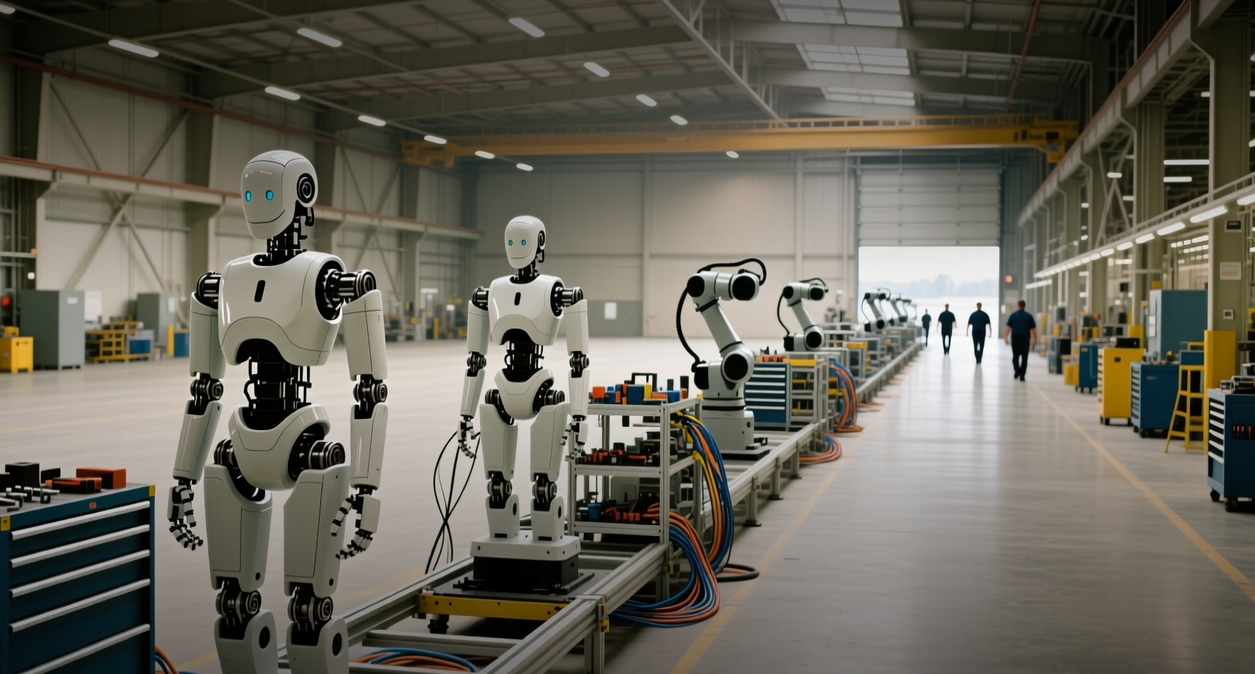
Tesla has begun producing its Optimus humanoid robot at Fremont, repurposing former Model S and Model X assembly space as the company commits more than $25 billion in 2026 capital spending to robotics and AI infrastructure.
"The production scaling challenge is very substantial," Elon Musk said on the company's Q2 earnings call. "This is going to be the hardest product to scale manufacturing that we've ever made at Tesla."
Every component of the robot is new, with no existing supply chain to draw from. Tesla has enlisted TSMC, Samsung, Panasonic, and Micron to build dedicated capacity, while constructing its own "Terafab" chip facility in Austin combining lithography, packaging, and testing under one roof.
The Fremont line targets 1 million robots annually, with Giga Texas slated for even larger output. Musk has warned initial production will be "agonizingly slow," but investors are pricing in a product Musk claims will represent 80 percent of Tesla's future worth.
The scale of the manufacturing challenge is reflected in how much outside help Tesla is enlisting. TSMC is building a new fab in Arizona and Samsung a new fab in Texas, with both companies committing tens of billions of dollars to expand AI compute chip capacity. Panasonic has poured additional billions into battery cell production, and Micron has set aside large memory allocations for Tesla on favorable terms.
Tesla is not relying solely on outside partners. Musk disclosed a new in-house chip facility — referred to internally as "Terafab" — under construction in Austin, combining lithography, logic and memory production, packaging, and chip testing under one roof. He called it a necessary investment, warning that without it Tesla "will be constrained in our ability to scale Optimus production because we simply won't have enough AI chips."
Tesla is far from alone in chasing the humanoid opportunity. Chinese manufacturers took the top six positions in Omdia's ranking of global humanoid robot shipments in 2025, with Tesla and Figure AI the only two U.S. companies to crack the top ten. Figure, widely viewed as Optimus's closest American rival, raised more than $1 billion in a September 2025 funding round that valued the company at $39 billion, and has been running a paid commercial pilot at BMW's Spartanburg, South Carolina plant. The company has said it aims to manufacture and deploy roughly 100,000 units within four years.
Wall Street's long-range estimates diverge sharply depending on time horizon. Goldman Sachs Research puts the addressable market for humanoid robots at $38 billion by 2035 — more than six times its earlier $6 billion estimate — with a base case of over 250,000 unit shipments in 2030, almost all of them industrial. Morgan Stanley Research projects the market could reach $5 trillion by 2050, with more than 1 billion humanoids in use worldwide and roughly 90 percent deployed in industrial and commercial settings. Morgan Stanley also estimates a single humanoid cost about $200,000 in 2024, falling to around $150,000 by 2028 and roughly $50,000 by 2050 — a trajectory that, even decades out, sits above the $20,000-to-$30,000 price Musk has said Optimus will eventually reach.
While Optimus captures headlines, Tesla has simultaneously discontinued the Solar Roof, the integrated glass-tile product Musk unveiled in 2016. The company has removed the product from its website and stopped accepting new orders, shifting its residential energy focus to standard solar panels, Powerwall batteries, and Megapack storage.
The Solar Roof never approached its early targets. By 2023, roughly 3,000 U.S. homes had the product installed, according to Wood Mackenzie data — far below Musk's original goal of about 1,000 installations per week. Musk himself acknowledged in 2021 that the company had made significant errors in assessing roof complexity, leading to price increases and project delays.
The two developments — Optimus entering production and Solar Roof exiting the lineup — tell a consistent story about where Tesla is placing its bets. The company is abandoning a hard-to-scale consumer product while pouring capital into an even harder-to-scale robotics program. The difference is the size of the prize: Musk has convinced a portion of the investment community that Optimus represents the bulk of Tesla's future value, while Solar Roof never became a meaningful profit driver.
For investors, the Fremont news is a milestone worth noting but not a reason to reprice the stock. The real test will come over the next several quarters, as Tesla attempts to move from a flat, constrained production start toward the steep portion of the S-curve — and as Giga Texas takes over the heavy lifting. The supply chain that doesn't yet exist will have to be built, component by component, before any of that can happen.
This article is for informational purposes only and does not constitute investment advice.
