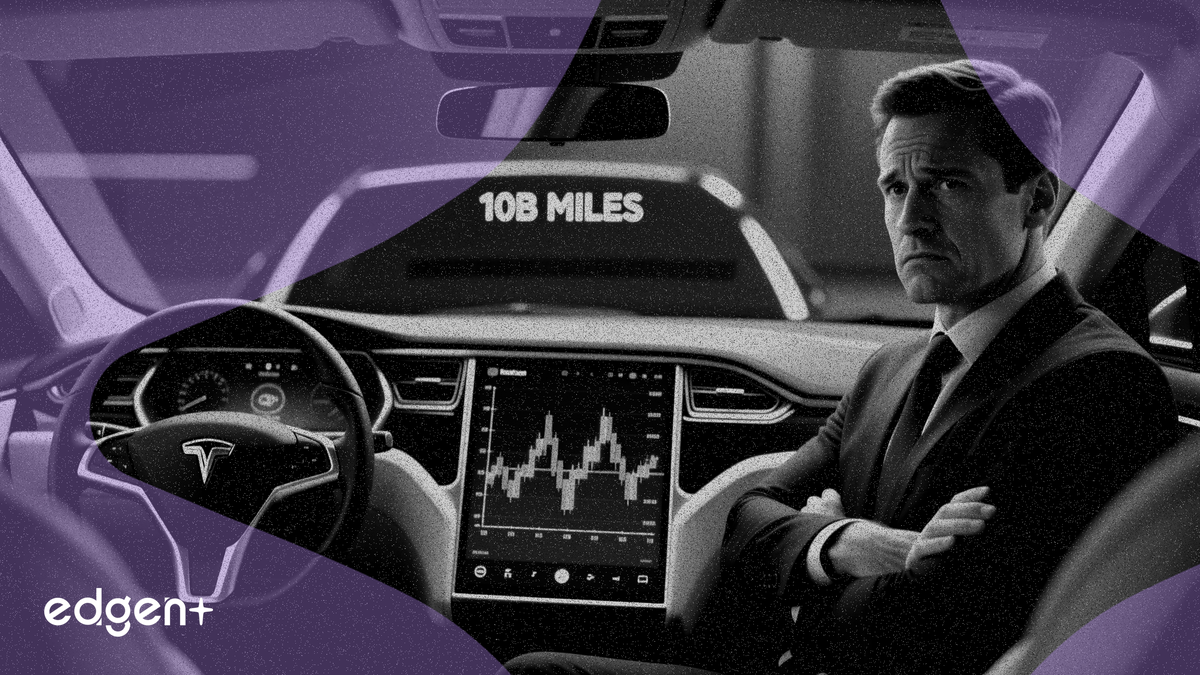
Tesla Inc. drivers have collectively surpassed 10 billion miles using the company’s Full Self-Driving system, a milestone that highlights the electric-vehicle maker’s vast data advantage but fails to deliver the breakthrough in autonomy that investors are awaiting. The achievement was met with a shrug by the market, showing that scale alone isn’t enough to convince investors that true self-driving is imminent.
Recent stock declines reflect investors’ desire to see more AI-related progress, such as unsupervised FSD, according to Al Root of Barron's. The stock closed at $389.30, down 0.8 percent, while the S&P 500 rose 0.8 percent.
The 10.05 billion-mile figure, published on Tesla’s FSD safety page, is a testament to the scale of the company’s data collection. However, the system remains a Level 2 driver-assist feature that requires constant human supervision. The news was paired with a separate, less consequential development for CEO Elon Musk, who will pay a $1.5 million settlement for failing to disclose his initial 5 percent stake in Twitter on time.
The core issue for investors is that Tesla’s market valuation, with a price-to-earnings multiple near 360, is heavily dependent on the company solving full autonomy. This milestone, while significant, does not change the fact that Tesla’s robotaxi service, now operating in Austin, Dallas, and Houston, continues to lag behind Alphabet Inc.’s Waymo, which operates a fully autonomous ride-hailing service in multiple cities.
Wall Street remains divided on the company’s prospects. Among 41 analysts covering the stock, 19 recommend buying, 17 suggest holding, and 5 advise selling, with a consensus price target of $398.42. The division reflects the uncertainty around Tesla’s ability to convert its data leadership into a commercially viable autonomous platform. Recent insider sales, totaling over 80,000 shares valued at approximately $30.85 million in the last quarter, further complicate the picture for investors.
Tesla shares, trading near a 50-day moving average of $383.09, are down 13 percent year-to-date but have gained 40 percent over the past 12 months. This performance, coupled with a first-quarter revenue figure that missed analyst expectations, suggests investors are looking for a concrete catalyst beyond incremental milestones. The path to justifying Tesla's AI-driven valuation depends on delivering a truly unsupervised driving experience, a goal Musk hopes to achieve by the end of the year.
This article is for informational purposes only and does not constitute investment advice.