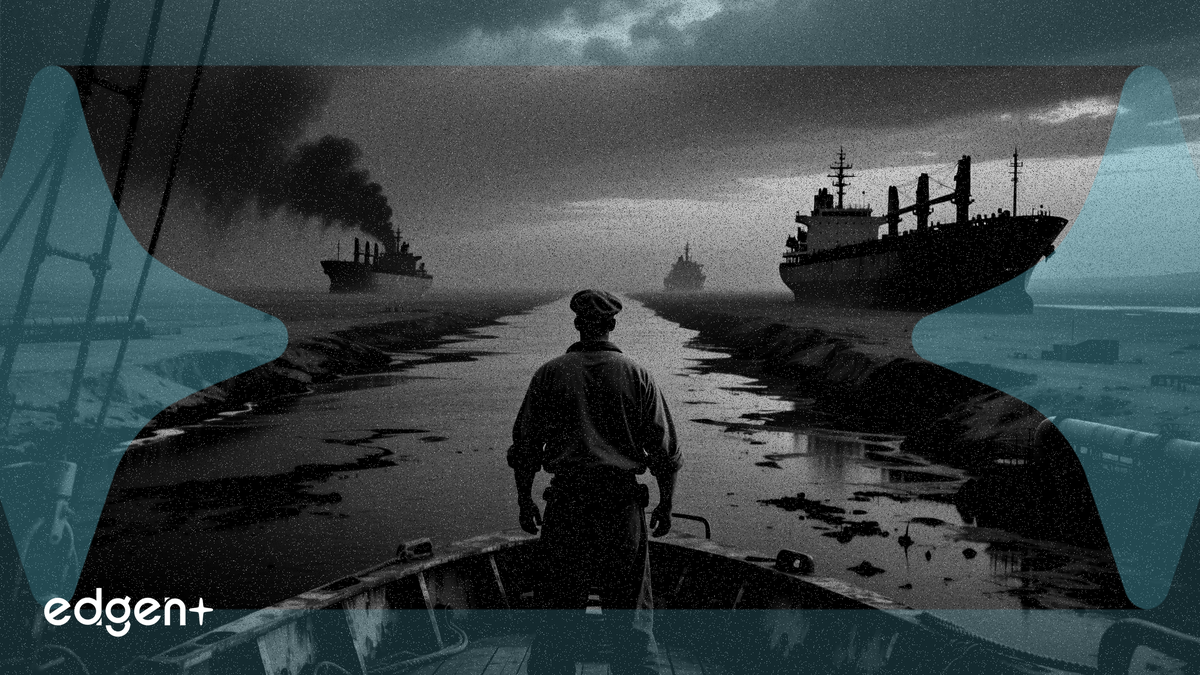
For 79 days, Chinese sailor Liu Yiwen has been trapped at the edge of the Strait of Hormuz, a fixed target in a conflict that has taken a fifth of the world’s daily oil supply offline and pushed global inventories toward critical levels.

A military blockade of the Strait of Hormuz, now entering its third month, is tightening its grip on the global economy as crude inventories fall at a record pace. The crisis, which has pushed Brent crude over $107 a barrel, is rooted in a fragile ceasefire between the U.S. and Iran, with a first-person account from a stranded sailor illustrating the human and economic cost of the standoff.
"We anticipate as that happens and the strait remains closed, that we will continue to see increased prices in the marketplace," Exxon Mobil CEO Darren Woods said on the company’s recent first-quarter earnings call, noting that inventory buffers are shrinking rapidly.
The supply disruption has sent U.S. gas prices to an average of $4.50 a gallon, levels not seen since 2022. Global oil inventories fell from over 8 billion barrels at the end of February to 7.8 billion by the end of April, according to an estimate from UBS. The International Energy Agency warned this week that rapidly shrinking buffers may herald future price spikes as the market heads into peak summer demand.
The standoff threatens to trigger a severe economic contraction if the strait remains closed into the third quarter, according to Rapidan Energy. While U.S. President Donald Trump insists his primary goal is preventing a nuclear-armed Iran, the escalating economic damage, costing Iran a reported $500 million per day and the U.S. taxpayer $29 billion to date, is intensifying pressure for a resolution as diplomatic negotiations falter.
The conflict’s sharpest edge is felt by sailors like Liu Yiwen, a chief officer on an oil and gas vessel anchored just five nautical miles from the port of Fujairah, a frequent target of missile attacks. "I went outside to look... and the missile was intercepted right above my head," Liu recounted after a May 4th attack. "You could clearly feel the shockwave, like a strong wind. Soon you could smell the smoke."
His vessel, carrying highly flammable liquefied gas, is a stationary target. For the hundreds of ships and thousands of seafarers stuck in limbo, fear is a constant companion, alongside dwindling supplies and the psychological strain of indefinite confinement. "In the beginning, you're like a cornered bird," Liu said. "After a month, you go a bit numb, but your nerves are always on edge."
While seafarers face the immediate danger, the global economy faces a slow-burning crisis. The world’s oil supply chain was cushioned in March and April by drawing down commercial and strategic reserves. But those buffers are finite.
JPMorgan analysts warned in an April 30 note that of the billions of barrels in storage, only about 800 million are available without straining the system to its breaking point. The bank forecasts that inventories could fall to a critically low level of 6.8 billion barrels by September if the strait is not reopened, a scenario that Rapidan Energy analysts say would cause the global economy to "seize up, with critical transportation infrastructure unable to source fuel at any price."
The economic pain is already spreading. In the U.S., President Trump is considering a temporary pause on the 18-cent federal gas tax to relieve consumers. The impact is more acute in Asia, which is heavily reliant on Gulf oil. Indian Prime Minister Narendra Modi has asked the nation’s 1.4 billion citizens to curtail fuel consumption, while countries from Indonesia to Pakistan have implemented mandatory remote work days to slash demand.
The crisis stems from a now-paused military conflict between the U.S. and Iran, dubbed "Operation Epic Fury." Despite a tenuous ceasefire, tensions remain high. President Trump recently called Iran’s latest peace offer “TOTALLY UNACCEPTABLE” and described the ceasefire as being on “massive life support.”
In response to U.S. statements, Iran’s IRGC Navy claimed it has expanded its definition of the Strait of Hormuz tenfold, from a narrow 20-mile channel to a strategic zone over 200 miles wide. While the U.S. has dismissed the announcement, Iran has continued to menace shipping with drones and small attack boats.
The Pentagon is reportedly preparing contingency plans for a renewed, larger military operation codenamed "Operation Sledgehammer" if diplomacy collapses. The situation is further complicated by an expanding regional conflict, with reports of direct, unpublicized strikes on Iranian soil by both Saudi Arabia and the UAE. For sailors like Liu, the geopolitical chess match translates into a daily reality of watching and waiting. "My birthday wish this year," he said, "was for world peace, and to go home soon."
This article is for informational purposes only and does not constitute investment advice.