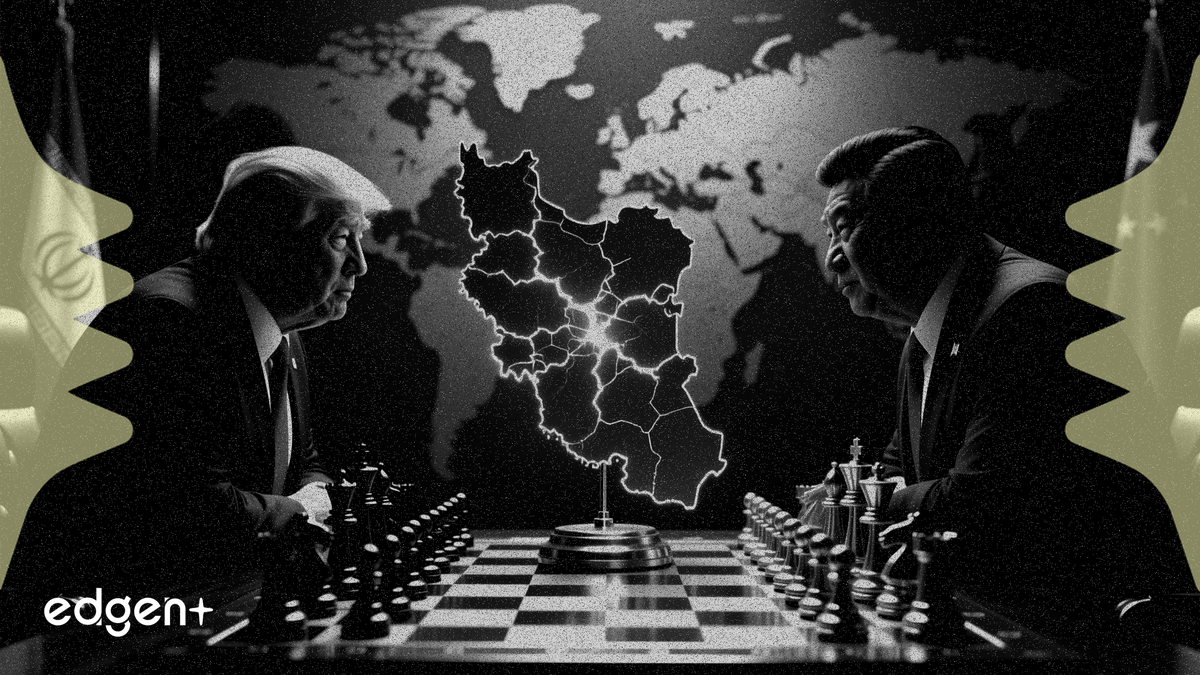
The world’s two largest economies confront a spiraling Middle East conflict that has choked off a fifth of the world’s oil supply and threatens to derail global growth.

US President Donald Trump arrives in Beijing this week for a high-stakes summit with Chinese leader Xi Jinping, where discussions over a faltering Middle East peace plan and a disruptive war in Iran are set to overshadow trade negotiations. The conflict has choked a critical artery for global energy, and Trump’s arrival comes just days after rejecting Iran’s latest counterproposal to a US-led peace deal as “TOTALLY UNACCEPTABLE.”
“Trump will have to juggle briefings and updates on two different, multifaceted sets of policy issues at once, all while a bit jet-lagged,” Jacob Stokes, deputy director of the Center for a New American Security think tank’s Indo-Pacific program, said. “Trump arguably faces a tight-wire act of simultaneous diplomacy and negotiation more complicated than any he’s yet seen in either of his presidencies.”
The war, which began over 10 weeks ago with coordinated US-Israeli strikes on Iran, has led Tehran to close the Strait of Hormuz. The closure has removed roughly a fifth of the world’s oil supply from the market, pushing the average US gasoline price up to $4.52 a gallon, according to AAA. The sustained disruption and rising prices have put a dent in Trump’s approval rating, with a recent Marist poll showing that 22 percent of Republicans now disapprove of his handling of the situation, up from 15 percent in March.
Both leaders have a vested interest in ending the conflict, but their approaches and end goals diverge. Trump, facing political pressure at home, is expected to push Xi to use his country’s leverage as a primary buyer of Iranian oil to help broker an agreement. Xi, in turn, wants to restore the flow of low-cost oil and secure regional stability to protect China’s economic interests, potentially elevating his status as a global statesman in the process.
Despite a cease-fire declared last month, the situation remains volatile. The United Arab Emirates reported new drone attacks from Iran on Sunday, and the US military confirmed its warships fired on Iranian coastal facilities last week after coming under attack. This state of “no war, no peace,” as analysts have termed it, underscores the difficulty of the negotiations. Tankers are reportedly switching off their tracking systems to navigate the strait, a sign of the high-risk environment for commercial shipping.
Trump’s administration has been inconsistent in its messaging, at times declaring the military campaign over while the president himself recently stated that Iran was “defeated, but that doesn’t mean they are done.” The core of the disagreement appears to be Iran’s nuclear program. The US proposal demands Iran “hand us the nuclear dust,” a reference to its enriched uranium, a concession Tehran has so far refused.
China’s role is complex. While it seeks an end to the fighting, it also aims to ensure the current Iranian regime remains intact. Beijing hosted Iran’s foreign minister just last week, a move widely seen as a signal of its ties to Tehran ahead of the summit. Furthermore, the US State Department recently sanctioned four Chinese entities for providing satellite imagery that allegedly enabled Iranian military strikes.
This transactional relationship means Xi is unlikely to simply concede to US demands. He will likely seek to balance pressure on Iran with his own strategic objectives, which include recovering from last year’s tariff war with the US and positioning China as an indispensable global power. For Trump, securing a diplomatic win is crucial to alleviating economic strain and bolstering his position ahead of the presidential election. The two-day meeting will test whether the world’s two most powerful leaders can find common ground or if the crisis will continue to escalate.
This article is for informational purposes only and does not constitute investment advice.