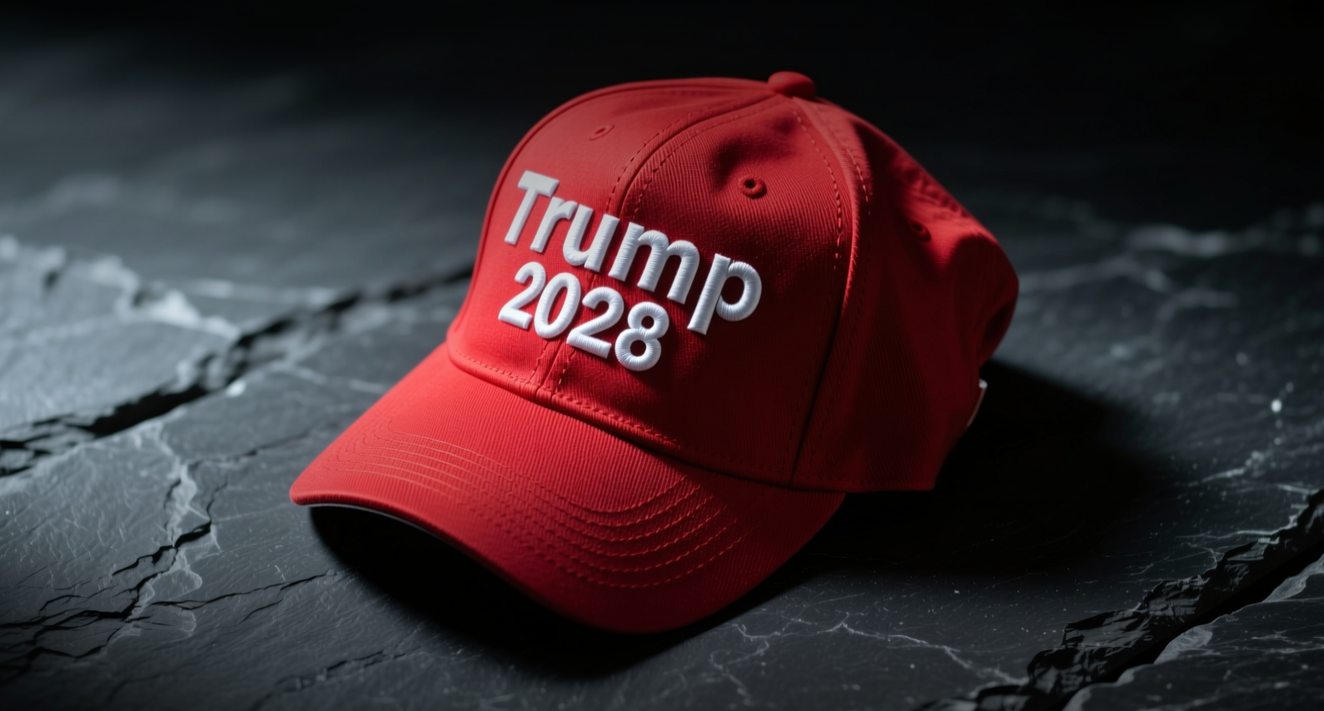
President Donald Trump announced his intention to run for a fourth term at the White House Correspondents' Association dinner on July 25, wearing a red "Trump 2028" hat — a declaration that landed as his approval rating hit a record low and the US-Iran conflict deepened.
"Tonight, to show just how much I care about the press and I want to save your ratings, I'm pleased to announce my intention to run for a fourth term as president of the United States," Trump told the audience, calling it "somewhat a piece of scoop." He added, "I won three times, now I'm going to do it again."
The announcement came as a Washington Post-Ipsos poll conducted July 8-13 among 2,648 US adults showed Trump's overall approval at 37%, with "strong approval" falling to a record-low 15% from 19% in February. Disapproval stood at 61%. The 22nd Amendment bars any person from being elected president more than twice, making the pledge constitutionally impossible — a detail Trump did not address.
The poll painted a grim picture across multiple fronts. Iran policy disapproval hit 69%, with 68% of respondents saying the military engagement with Iran is "not worth fighting." About 67% expressed no confidence that US military operations or ongoing negotiations would prevent Iran from developing nuclear weapons. On the economy, 67% of Americans expect conditions to worsen over the next year, while 43% said their current living situation is worse than when Trump returned to the White House.
Escalation in the Strait of Hormuz
The souring public mood coincides with a sharp escalation in US-Iran hostilities. The US resumed military strikes on Iran on June 26, citing attacks on commercial shipping transiting the Strait of Hormuz, and Trump reinstated a naval blockade on July 13 after a brief diplomatic window. The president formally notified Congress of renewed hostilities, telling Fox News the campaign would continue until "I say enough."
The Strait of Hormuz handles about 21% of global oil trade, making the blockade a direct threat to crude supply lines. The last time the US imposed a similar blockade in the region — during the 2019 tanker crisis — Brent crude spiked more than 15% over six weeks before diplomatic channels reopened. WTI and Brent prices have already begun pricing in a sustained disruption premium, though exact levels were not yet disclosed at press time.
A Political and Economic Crossroads
The combination of a constitutionally dubious fourth-term bid, a deeply unpopular foreign conflict, and broad economic pessimism creates an unusually volatile backdrop for risk assets. Defense contractors may see a tailwind from sustained military spending, while consumer discretionary sectors face headwinds from deteriorating household confidence. The 67% of Americans expecting economic deterioration represents the most pessimistic consumer outlook since comparable polling during the 2008 financial crisis.
Trump's WHCA appearance was largely aimed at taunting the press — he called the room "the largest group of 'Trump derangement syndrome' people ever put together" — but the underlying data tells a different story. With midterm elections approaching and a military conflict that 68% of Americans oppose, the political calculus around a fourth-term campaign may prove far less entertaining than the announcement itself.
This article is for informational purposes only and does not constitute investment advice.