
President Donald Trump said the US will seize Iran's Kharg Island, threatening to remove as much as 2.5 million barrels a day from global oil markets.
President Donald Trump said the US will seize Iran's Kharg Island, threatening to remove as much as 2.5 million barrels a day from global oil markets.
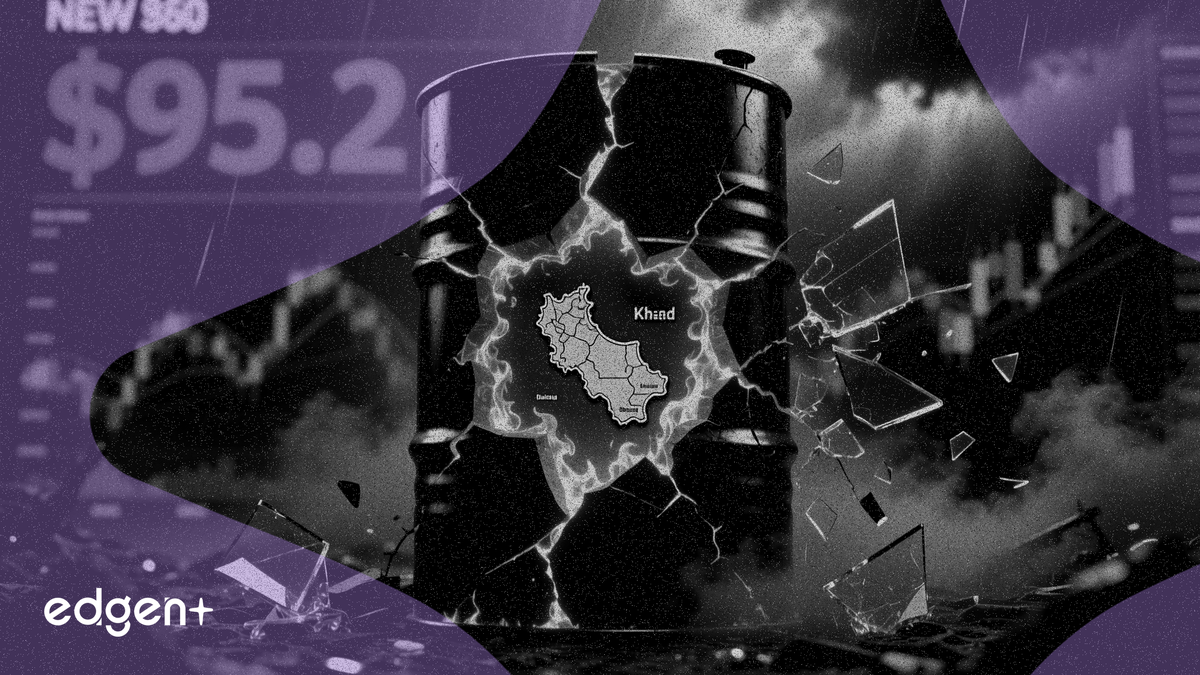
President Donald Trump said the US will seize Iran's Kharg Island, threatening to remove as much as 2.5 million barrels a day from global oil markets.
Trump said the US will seize Iran's Kharg Island in a military operation Thursday, threatening to cut off the Islamic Republic's primary oil export terminal and remove as much as 2.5 million barrels a day from global supply.
"This is the most direct threat to Iranian oil infrastructure since the Tanker War in the 1980s," said Helima Croft, head of global commodity strategy at RBC Capital Markets. "Seizing Kharg would represent a structural supply shock, not a temporary disruption."
Brent crude surged above $95 a barrel, up more than 4% on the day, while Nasdaq 100 futures pared gains to 0.65%. Spot gold dropped $20 to $4,069.45 an ounce as the dollar strengthened on safe-haven flows. The Strait of Hormuz, through which about 21% of global oil trade passes, remains effectively shut after weeks of US-Iranian exchanges that have already disabled eight vessels.
Kharg Island handles roughly 90% of Iran's crude exports, making it the single most valuable energy asset in the Persian Gulf. A successful seizure would give Washington de facto control over Iran's oil and gas market, potentially adding $15 to $20 a barrel in risk premium to global crude benchmarks and reigniting inflation fears across developed economies.
The escalation marks a dramatic shift in the US-Iran confrontation that began with Israeli strikes on Beirut in early April. Since then, the conflict has spiraled through multiple rounds of retaliation — from Iranian direct attacks on Israel to US strikes on Iranian air defense systems and a naval blockade of Iranian ports. The US military's Central Command said it struck Iranian military surveillance capabilities, communication systems and air defense sites across Iran over the past 48 hours. Three Indian sailors were killed Thursday after a US strike on an oil tanker in the Gulf of Oman, the second such attack on commercial shipping this week.
Kharg Island's Strategic Value
Kharg Island, located about 25 kilometers off Iran's coast in the northern Persian Gulf, handles the vast majority of Iranian crude exports — roughly 2 million to 2.5 million barrels per day. The terminal's storage capacity exceeds 28 million barrels, and it serves as the loading point for tankers destined for China, India, South Korea and other Asian refiners. The last time a major power threatened Iranian oil infrastructure at this scale was during the Iran-Iraq War in the 1980s, when Saddam Hussein's air force repeatedly bombed Kharg, temporarily cutting exports by as much as 75%. Iran subsequently rebuilt and fortified the terminal, but its geography — a single island with limited air defense coverage — remains a vulnerability.
Market Fallout and Forward Scenarios
If the US successfully seizes and holds Kharg, Iranian exports could effectively drop to zero, removing roughly 2% to 2.5% of global oil supply overnight. The International Energy Agency has estimated that global spare production capacity — held primarily by Saudi Arabia and the UAE — stands at about 4 million to 5 million barrels a day, enough to offset a full Iranian outage but not without significant price dislocation.
"If the Strait of Hormuz remains effectively closed and Kharg is taken, we're looking at a supply shock that could push Brent above $110," Croft said. "The question is whether Saudi Arabia would ramp up output to stabilize prices or use the moment to capture market share."
Options markets are already pricing elevated tail risk. Brent crude options skew has shifted sharply to the upside, with out-of-the-money call premiums surging as traders hedge against a spike above $110. Defense sector stocks in the US and Europe have rallied, with the S&P 500 aerospace and defense index gaining 2.3% this week.
Trump warned Thursday that more strikes are likely if Iran does not agree to a deal, telling Fox News he would "bomb the [expletive] out of them." Iran's Foreign Ministry said Wednesday it would "need to reassess" the diplomatic path after days of clashes, raising the prospect of further retaliation.
This article is for informational purposes only and does not constitute investment advice.
