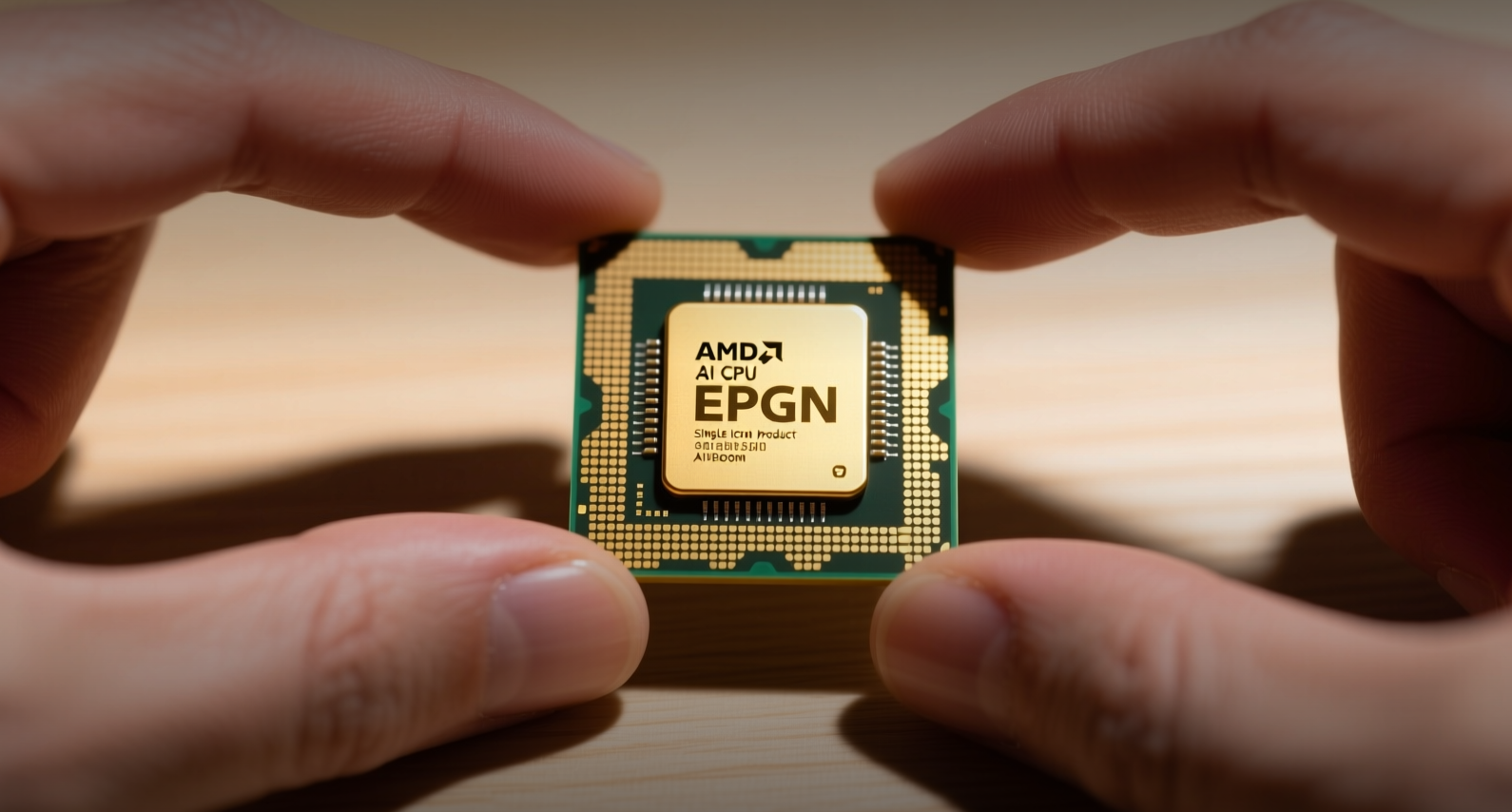
The CPU is reemerging as the control hub of AI infrastructure, driving a wave of analyst upgrades across the semiconductor supply chain as workloads shift from training to agentic inference.
UBS analyst Timothy Arcuri raised Advanced Micro Devices Inc.'s price target to $670 from $455 and Arm Holdings Plc's to $470 from $260, betting that standalone CPU racks will capture a growing share of AI infrastructure spending. "AMD has a distinct advantage in standalone agentic AI racks, which are more core and throughput-driven," Arcuri, who maintained a Buy rating on both stocks, said in a note Wednesday.
The upgrades rest on a structural shift in how AI systems are built. UBS now forecasts AMD's server CPU revenue will reach $23 billion in 2027, $29 billion in 2028 and $50 billion by 2030, up from a prior estimate of $41 billion for that final year. The bank expects x86 architecture to capture 60% of the standalone AI server market, with AMD absorbing most of that incremental demand given Intel Corp.'s roadmap and supply challenges. Arm, meanwhile, is projected to claim roughly 70% of the head-node CPU market — processors that connect to graphics processing units — by 2030, reflecting the expansion of Nvidia Corp.'s Grace and Vera chips alongside Google LLC's Axion and Amazon.com Inc.'s Graviton.
The broader market opportunity is enormous. UBS projects the global server CPU market will expand to more than $170 billion by 2030 from roughly $35 billion in 2025, a fivefold increase driven by the rise of agentic AI — systems that plan tasks, call tools, access databases and manage complex workflows. These workloads rely heavily on sequential processing, low-latency data management and high input-output throughput, areas where CPUs outperform GPUs. The shift positions the processor as the "control hub" of AI systems rather than a mere host processor for accelerators.
AMD's EPYC Franchise Gains as x86 Captures 60% of Standalone AI Racks
AMD's opportunity is rooted in the technical demands of agentic AI. Standalone AI servers — systems that run inference and task orchestration without a GPU co-processor — favor high core counts and multithreading performance, areas where AMD's EPYC line leads. The company's server CPU revenue already reflects this momentum: AMD reported $10.25 billion in total revenue for the first quarter of fiscal 2026, up 38% year over year, with data center revenue jumping 57% to $5.78 billion. Management guided for roughly $11.2 billion in second-quarter revenue, implying 46% year-over-year growth.
The customer pipeline is unusually deep. Meta Platforms Inc. committed up to 6 gigawatts of Instinct GPUs with AMD named lead supplier for sixth-generation EPYC processors. Oracle Corp. built a 50,000-GPU Helios supercluster using AMD silicon, and an OpenAI agreement covers 6 gigawatts of GPU deployment. These wins anchor a loaded order book that bulls argue underwrites the new UBS target.
AMD shares traded near $521 Wednesday, roughly flat on the session, with the stock sitting below its 52-week high of $562.99. The $670 target implies roughly 29% upside from current levels, though the stock's trailing price-to-earnings ratio of about 172 times leaves little room for execution missteps.
TSMC and ASE Emerge as Structural Beneficiaries of CPU Expansion
The CPU buildout is not just a chip designer story. Bank of America Corp. simultaneously raised targets on Taiwan Semiconductor Manufacturing Co. Ltd. and ASE Technology Holding Co. Ltd., arguing that rising CPU demand will drive a parallel expansion in advanced manufacturing and packaging.
BofA estimates the global server CPU-related semiconductor manufacturing market will grow to $49 billion by 2028 from $15 billion in 2025, with outsourced production's share rising to 71% from 52%. That shift benefits TSMC, which manufactures both AMD's EPYC chips on its 3nm and 4nm nodes and Arm-based server processors for Nvidia, Amazon and Google. The foundry's CoWoS (chip-on-wafer-on-substrate) advanced packaging technology is also in high demand as chiplet-based CPU designs proliferate.
The packaging opportunity is equally significant. BofA projects the server CPU-related packaging and testing market will expand to $9.6 billion by 2028 from $1.9 billion in 2025, with its share of the total advanced packaging market rising to 24% from 11%. ASE, the world's largest semiconductor packaging and testing provider, stands to benefit as chiplet architectures require more complex integration and longer test cycles, increasing the value per chip.
For investors, the coordinated upgrades from two major banks around the "CPU as AI control hub" narrative signal a potential sector-wide re-rating. AMD's 172x trailing multiple prices in aggressive growth, but the $170 billion addressable market projection by 2030 provides a long-term anchor if execution holds. TSMC and ASE offer a lower-risk way to play the same trend, capturing manufacturing and packaging revenue regardless of which chip architecture wins the architectural debate. The key risk remains U.S. export controls: AMD previously absorbed an $800 million inventory charge tied to China restrictions, and any tightening could reset the demand trajectory for the entire supply chain.
This article is for informational purposes only and does not constitute investment advice.