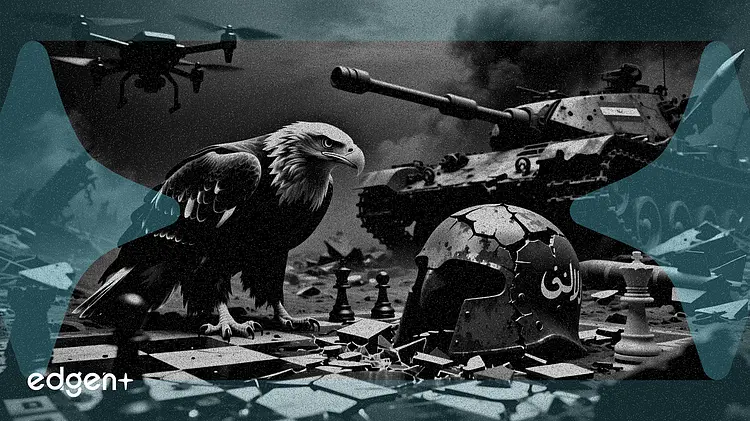
Two wars on separate continents are reshaping the global order by proving that military might no longer guarantees victory.
The US military has failed to secure a strategic victory over Iran despite killing much of its leadership, while Russia remains bogged down in Ukraine after more than four years of war — exposing the narrowing gap between superpowers and the nations they seek to subdue.
"The kind of war to which we were used — to invade and occupy a nation — is no longer conceivable," said Guido Crosetto, Italy's defense minister, in an interview. "Conquering a nation when its citizens are ready to fight is impossible even when there is disparity in strength."
Russia suffered about 35,000 casualties in April alone, equivalent to its monthly quota for contracted recruits, while Ukraine has held the front line and intensified long-range strikes on Russian territory. The US, despite deploying significant long-range munitions and removing Venezuelan strongman Nicolás Maduro in a January covert operation, has been unable to break Iran's blockade of the Strait of Hormuz — a chokepoint handling about 21% of global oil trade. Tehran continues to lob missiles at Israel and Gulf states, with the latest exchange of salvos this week.
The implications extend beyond the battlefields. China is closely watching these conflicts as it weighs options on Taiwan, while middle powers from Canada to the Gulf states are forging new security arrangements independent of Washington and Moscow. "If they are united, the middle powers can counter the great powers," said Nicolas Tenzer, a French political scientist.
Drones and precision missiles level the field
Technological advances — particularly drones and cheaper precision missiles — have eroded the conventional advantages that once allowed superpowers to overwhelm smaller adversaries. Ukraine has turned the tide of the war through battlefield innovation, holding the front line even after President Donald Trump cut off American aid more than a year ago and pressed Kyiv to surrender the eastern Donetsk region at an August summit with Russia in Alaska.
"Ukraine is on a much more solid footing because of the technological superiority that they've got," said Baiba Braže, Latvia's foreign minister.
The drone warfare revolution, spurred by the Russia-Ukraine conflict and Iran's development of precise long-range ballistic missiles, has partially offset the US advantage in air power and intelligence. Gen. Onno Eichelsheim, the Netherlands' chief of defense, said regime change can no longer be achieved by force of arms alone. "It is almost impossible to conquer such nations with all the capability that you have," he said. "If you don't succeed within the first two weeks, then you end up in a stalemate position."
The last time the US attempted a comparable ground invasion was Iraq in 2003, which led to a protracted insurgency. The swift removal of Maduro in January now appears as an exception rather than a template for future American power projection.
Middle powers seek new alliances
The wars have accelerated a global realignment. Canadian Prime Minister Mark Carney, whose country has been referred to by Trump as a potential 51st state, invoked the ancient Greek historian Thucydides at the World Economic Forum in Davos in January — "The strong do what they will, and the weak suffer as they must" — to argue that middle powers must cooperate to avoid subordination to hegemons.
Since then, European nations, Asian democracies and Canada have strengthened military, economic and security ties to offset dependence on both the US and China. The Joint Expeditionary Force, which includes the UK, Nordic and Baltic states, has increasingly served as a forum for coordinating military assistance to Ukraine.
Taiwan presents a contrasting case. Its opposition-dominated parliament in May passed a $25 billion special military spending package that cut funding for domestically designed drone and asymmetric-warfare capabilities — the opposite lesson from Ukraine, said Singaporean academic Bilahari Kausikan. "The lesson is not that democracies help other democracies," he said. "The lesson is that Ukrainians helped themselves."
The Philippines, locked in a maritime dispute with Beijing, faces a similar challenge. "Our populations have been so shielded from the reality of conflict," said Defense Secretary Gilberto Teodoro Jr. "In order to have that, you need to have a strong security and defense cladding."
Retired Senior Col. Zhou Bo, a former director at China's Ministry of Defense Center for Security Cooperation, said Beijing's main takeaway should be to study modern drone warfare. "China is the largest producer of drones, but we don't know how to use them, militarily, really," he said. "It's only these countries that have used drones in the battlefield that can tell you how effective they really are."
This article is for informational purposes only and does not constitute investment advice.