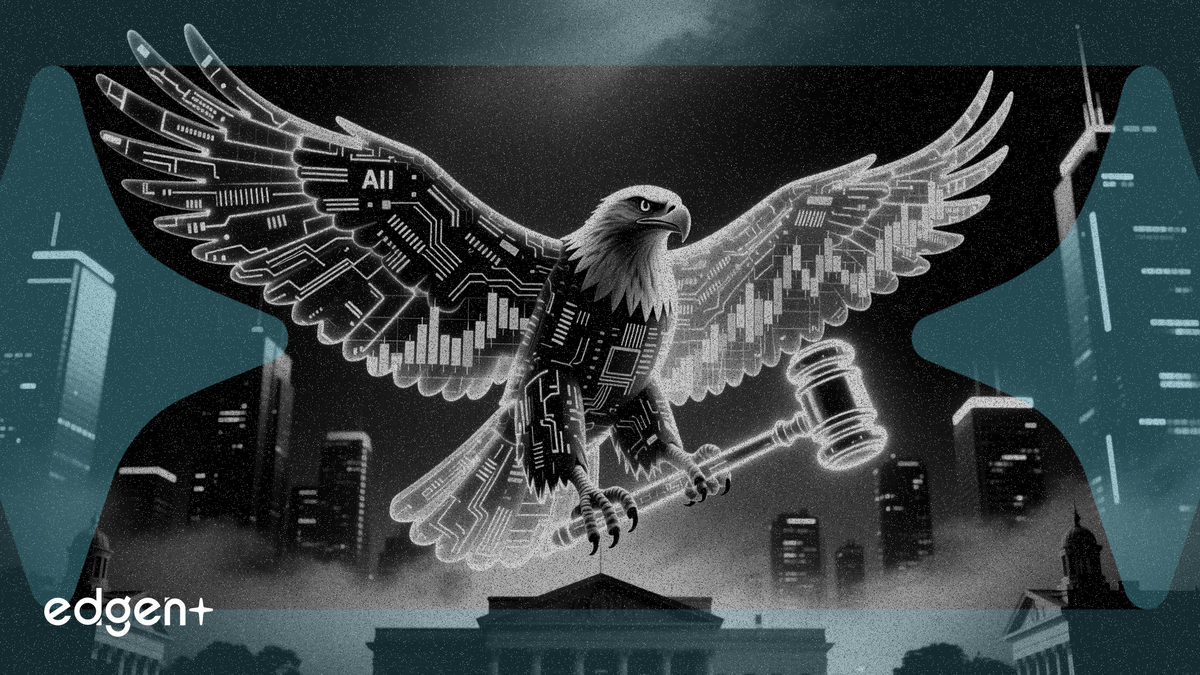
Senior US officials held preliminary discussions with major artificial intelligence companies about the federal government purchasing equity stakes in their firms, according to three people familiar with the matter cited by NOTUS on Thursday — a move that would mark a significant shift in Washington's approach to regulating the technology sector.
"The government taking equity positions in AI companies represents a fundamental rethinking of how the state engages with transformative technology," said James Okafor, macro policy analyst at Edgen. "It moves the federal role from regulator to shareholder, which carries both oversight advantages and conflicts of interest."
The talks, whose participants and timing were not disclosed, come as the Trump administration has already accumulated ownership stakes in at least 20 private companies, according to estimates by the Cato Institute. These range from mineral producers such as MP Materials and Lithium Americas to semiconductor firms including Intel and xLight, and quantum computing leaders IBM and GlobalFoundries. Last month, the administration announced plans to take $2 billion in equity stakes across nine quantum computing companies as part of a broader push to maintain US leadership in strategically critical technologies.
The discussions signal a convergence between the administration's existing industrial policy and a separate proposal from Senator Bernie Sanders, who introduced the American AI Sovereign Wealth Fund Act. The legislation would impose a one-time 50% tax on the stock of OpenAI, Anthropic and xAI, paid in shares, depositing the equity into a public fund that would give ordinary Americans voting rights and board representation. Sanders argued in a New York Times op-ed that AI models were built on "the creative work of millions of people" that had "essentially been stolen by some of the wealthiest people in the world."
A Bipartisan Consensus Takes Shape
The emerging alignment between the independent Vermont senator and the Trump administration reflects a broader political realignment around state intervention in technology. Senator Elizabeth Warren published her own AI tax proposal in Time magazine days before Sanders' piece appeared, calling for a levy on AI to compensate workers displaced by automation. "Taxing AI is one way we make sure the winnings from AI benefit all Americans," she wrote.
The UK has already moved in a similar direction. The government launched a £500 million Sovereign AI Fund in April, designed to back AI firms and infrastructure with the state taking equity stakes and a share of any upside. Jim Rowan, the former Volvo Cars chief executive who now chairs Glasgow-based accelerator STAC, described the fund as "a massive step in the right direction" and drew parallels to Singapore's sovereign wealth funds, which were given explicit mandates to build the city-state's technological capabilities over multi-decade horizons.
Critics argue that government equity stakes create fundamental conflicts. When the state becomes a major shareholder, regulatory neutrality collapses — referees with a financial stake in the outcome are no longer impartial. The Cato Institute has noted that Norway and Alaska built their sovereign wealth funds from resources the government already owned, not from forced equity transfers from private companies.
The financial stakes are enormous. Quantinuum, Honeywell's quantum computing subsidiary, raised $1.68 billion in its US initial public offering on Wednesday at a valuation of $15.6 billion — roughly 504 times its 2025 revenue of $30.9 million. The company's IPO was upsized from an initial 26.5 million shares to 28 million, pricing above the marketed range of $53 to $55 per share. Honeywell will retain about 48.1% of combined voting power after the offering closes.
For the AI sector, the implications extend beyond ownership structure. Tech layoffs in 2026 have already surpassed 142,000, with companies including Meta, Atlassian and Cloudflare explicitly citing AI investment as the reason for workforce reductions. Software developer employment for workers aged 22 to 25 has fallen roughly 20% from its 2024 peak, according to industry data. If the government becomes both a shareholder in AI companies and a regulator of labor markets, the potential for policy conflicts will only intensify.
This article is for informational purposes only and does not constitute investment advice.