
Incoming Fed Chairman Kevin Warsh is pushing the central bank to adopt alternative inflation measures that show price pressures running well below the standard gauges, a shift that could reshape the monetary policy outlook.
Incoming Fed Chairman Kevin Warsh is pushing the central bank to adopt alternative inflation measures that show price pressures running well below the standard gauges, a shift that could reshape the monetary policy outlook.
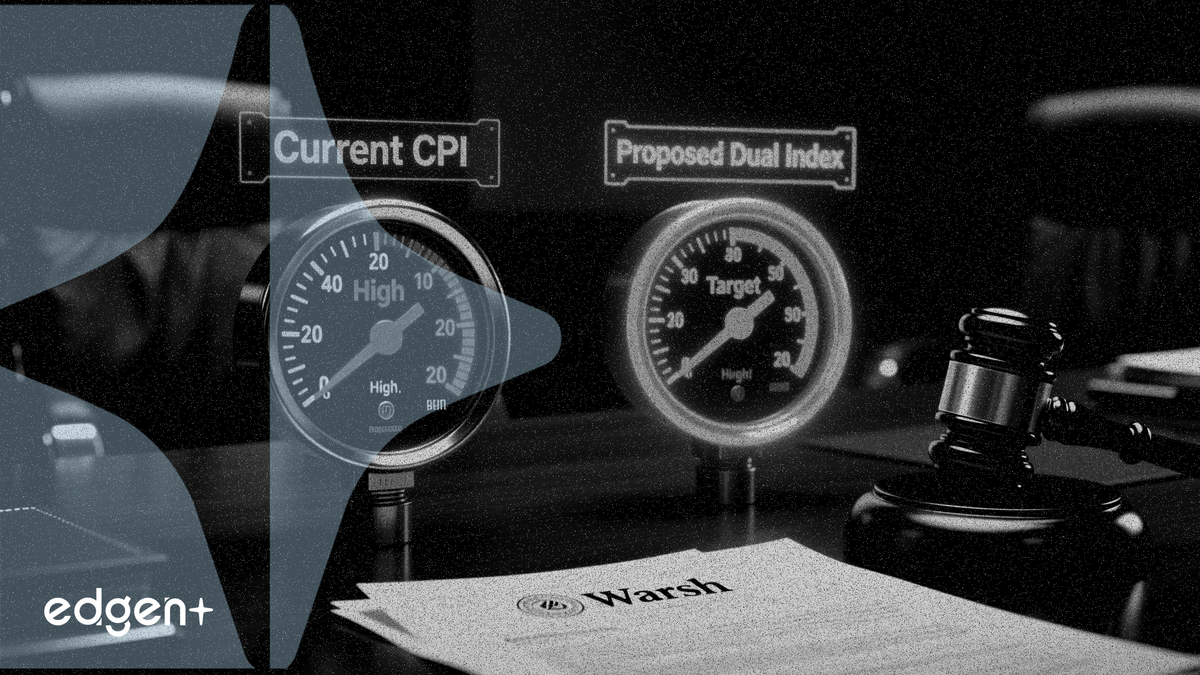
Incoming Fed Chairman Kevin Warsh is urging the central bank to adopt alternative inflation measures that show price pressures running well below the standard 3.8% personal consumption expenditures reading, a potential shift in the policy framework that could open the door to rate cuts.
Warsh has argued that the Fed's standard inflation gauges overstate underlying price pressures and that alternative measures — including trimmed-mean and median CPI variants — paint a significantly cooler picture, according to people familiar with his thinking. The push comes as the central bank's benchmark rate sits at 3.50%-3.75%, where it has remained since the last 25-basis-point cut in September 2025. OIS markets currently price a 65% probability of a rate hike by the December meeting, according to CME FedWatch data.
"It still seems early to assess the size and persistence of the economic effects from the Iran conflict," Fed Vice Chair for Supervision Michelle Bowman said Friday at a conference in Iceland, adding that "should disruptions persist well into the second half of the year, we could start to see broader effects on inflation." Bowman, one of the central bank's most dovish policymakers, said she would "consider shifting my approach to thinking about the balance of risks."
The debate over measurement methodology is unfolding against a backdrop of conflicting signals. The New York Fed's underlying inflation gauge jumped to 4% in April from 3.5% in March, while the government's PCE price index rose to 3.8% year-over-year from 3.5% — both well above the Fed's 2% target. Prices of goods and services excluding housing accelerated in April relative to the prior month, the data showed.
Yet Warsh's alternative measures tell a different story. Trimmed-mean inflation, which strips out extreme price movements, and median CPI, which captures the center of the price distribution, both show core inflation running closer to 2.5% — a level that would fundamentally alter the Fed's reaction function. The last time the Fed seriously debated alternative inflation metrics was during the 2019 framework review, which ultimately led to the adoption of average inflation targeting in August 2020. The S&P 500 rose 16% in the 12 months following that announcement as markets priced in a more accommodative stance.
The Cross-Asset Stakes
If the Fed under Warsh shifts toward measures showing lower inflation, the implications would ripple across markets. The 2-year Treasury yield, which is most sensitive to Fed policy expectations, would likely decline from its current level near 4.15%, while the dollar could weaken against major currencies. A more dovish framework would also support risk assets: the S&P 500 has historically gained an average of 8% in the six months following a dovish Fed pivot, according to data from Bespoke Investment Group.
Kansas City Fed President Jeffrey Schmid, speaking at the same conference as Bowman, said his "primary concern is inflation, which is too hot and has been above target for too long." He added that the textbook strategy of looking through an energy shock as something that won't have a lasting impact is not viable. Schmid also suggested the Fed could use its balance sheet to tighten, saying "maybe we look at the balance sheet again as another tool to create some restriction."
That view puts Schmid at odds with Warsh, who has expressed skepticism about using the central bank's bond holdings to augment interest rate policy. Money market conditions and the Fed's rate-control toolkit limit how far those holdings can be shrunk without creating market volatility, Warsh has argued. The central bank is currently rebuilding liquidity after conditions tightened late last year.
Philadelphia Fed President Anna Paulson said Friday that monetary policy is "well positioned" but that the Fed is ready "to react," noting that "it is healthy that market participants have taken on board scenarios where the funds rate remains unchanged for an extended period, as well as scenarios where further tightening becomes necessary."
The next Fed meeting is scheduled for June 16-17, where the rate decision will be accompanied by updated economic projections and the first dot plot under Warsh's chairmanship. Whether those projections reflect the alternative inflation framework Warsh has advocated will be the defining question for markets in the second half of the year.
This article is for informational purposes only and does not constitute investment advice.
