
Kevin Warsh used his debut as Fed chair to hold rates steady while the central bank's dot plot pointed to a quarter-point hike before year-end.
Kevin Warsh used his debut as Fed chair to hold rates steady while the central bank's dot plot pointed to a quarter-point hike before year-end.
Kevin Warsh used his debut as Fed chair to hold rates steady while the central bank's dot plot pointed to a quarter-point hike before year-end.
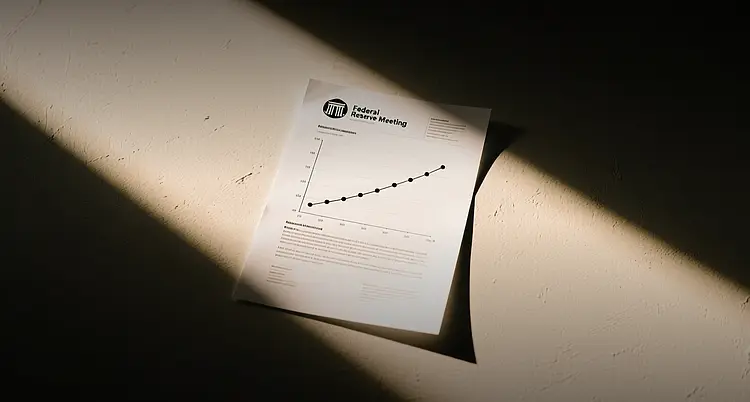
The Federal Reserve held rates at 3.5%-3.75% at Kevin Warsh's first meeting as chair Wednesday, but a dot plot pointing to a quarter-point increase by year-end pushed the 2-year Treasury yield up 14.4 basis points.
"The bond bid reflects positioning for a hawkish Fed under new leadership," said Rick Rieder, head of fixed income at BlackRock. "Today we believe the FOMC ushered in a new era of monetary policy in the United States."
The FOMC split 9-9 between officials expecting steady rates or one cut and those seeing at least one hike, with the median dot projecting a quarter-point increase. Warsh confirmed he did not submit a dot, consistent with his long-held skepticism of forward guidance. The post-meeting statement ran just 130 words, down from the typical 300-plus. Major equity averages swooned after the release and during Warsh's press conference, with the S&P 500 falling 1.8% and the Nasdaq dropping 2.3%.
The hawkish debut marks a sharp departure from the Powell era. Inflation has run between 3.3% and 3.8% for more than five years, roughly double the Fed's 2% target. Warsh used the term "price stability" about a dozen times during his press conference, describing the committee's resolve as "strong, unanimous, and unambiguous." Markets now price a rate hike before the end of 2026, with CME FedWatch data showing a 58% probability of a quarter-point increase at the December meeting.
Warsh, who succeeded Jerome Powell on May 22, announced the formation of five task forces charged with studying communication, the Fed's balance sheet, data sources, productivity and jobs, the impact of artificial intelligence, and the central bank's inflation approach. "The announcements signal an institution in active review rather than steady state," said Jason Pride, chief of investment strategy at Glenmede. "Investors should expect the operating framework of the Fed to look meaningfully different over Warsh's tenure."
The last time a new Fed chair used his debut to signal a policy pivot was Powell in 2018, when the Fed raised rates four times that year before reversing course in 2019. The S&P 500 fell 6.2% in the three months after Powell's first hawkish move, according to data compiled by Bloomberg. The dollar index rose 3.4% over the same period as higher rates attracted capital inflows. Warsh's own history as a Fed governor from 2006 to 2011 — a period that included navigating the global financial crisis — gives him credibility on inflation fighting, but his personal financial disclosures revealed holdings in Solana and Ethereum, which he has pledged to divest.
"New Fed Chair Warsh sounded a bit like old hawkish Fed governor Warsh at his press conference today, repeating multiple times the need for the Fed to deliver on its mandate for price stability," said Krishna Guha, head of central bank strategy and economics at Evercore ISI.
The Treasury market's initial recovery after Warsh's comments suggests bond traders believe the new chair means business. A US-Iran agreement reached in mid-June has helped ease some inflationary pressure on energy prices, with Brent crude falling 4.2% since the deal was announced. But with core inflation still running well above target, the Fed's path remains tight. "Warsh wants his first impression to be as 'the reformer,'" said Dario Perkins, managing director of global macro at TS Lombard. "We'll see what that means later this year. In terms of the policy outlook, Fed watching just got harder."
The hawkish repricing rippled across asset classes. The dollar index rose 0.6% against a basket of major currencies, while gold fell 1.2% to $2,318 an ounce. Bitcoin dropped 3.4% to $67,200, extending its decline as higher-for-longer rate expectations reduced appetite for risk assets. Warsh's personal holdings in Solana and Ethereum — which he has pledged to divest — added an unusual layer of scrutiny to the central bank's crypto policy stance.
If inflation data over the coming months stays sticky in the 3.3% to 3.8% range, the Fed will have little choice but to tighten further. OIS markets will need to reprice the probability of a hike at the next meeting, with the dot plot already pointing to one quarter-point increase before year-end. The next FOMC meeting is scheduled for July 28-29.
This article is for informational purposes only and does not constitute investment advice.
