
Key Takeaways: The AI investment boom is tracking the social media era more than the telecom bust, with data center power demand set to nearly double by 2028.
Key Takeaways: The AI investment boom is tracking the social media era more than the telecom bust, with data center power demand set to nearly double by 2028.
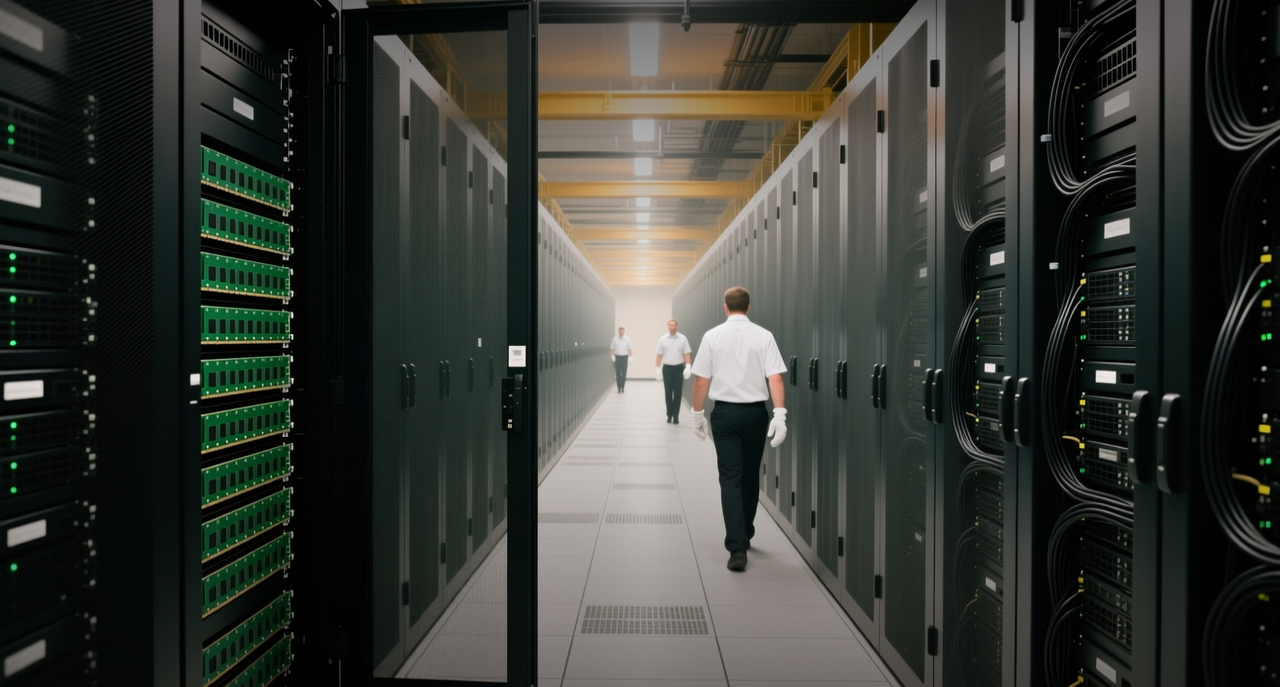
The AI investment boom resembles the social media era more than the telecom bust of the late 1990s, with U.S. data center power demand set to nearly double from 80 gigawatts to 150 gigawatts by 2028, according to a Wall Street Journal commentary.
"It's their world and everyone else is paying rent," Dan Ives, tech analyst at Wedbush Securities, said of memory-chip makers riding the AI cycle.
The distinction matters because the two prior cycles ended differently. Telecom carriers overbuilt fiber networks that lacked paying customers, wiping out billions in capital. The social media era produced durable cash flows as platforms monetized users at scale. AI's current buildout shows signs of the latter: hyperscale data center investment is pushing server rack thermal loads to 30-60 kilowatts, well above the 20-25 kilowatt threshold where conventional air cooling becomes impractical, according to BCC Research. That has created a $2.2 billion vapor chambers market forecast to reach $4.0 billion by 2031, a 10.8 percent compound annual growth rate.
The stakes are visible in equity markets. The iShares MSCI USA Value Factor ETF, up 44 percent year to date, carries a roughly 20 percent weighting in Micron, whose AI-driven memory demand has made the fund an unusual blend of value and growth. The Roundhill Memory ETF, trading at $56.40 with $25.74 billion in assets, has seen outflows even as Micron, SK Hynix and SanDisk post strong revenue growth — a sign investors are weighing cyclical risk against the AI tailwind.
The telecom analogy dominated early AI commentary because both cycles involved massive infrastructure spending ahead of proven demand. But the economics diverge sharply. Telecom carriers borrowed heavily to lay fiber, then competed on price as capacity exceeded traffic, collapsing margins across the sector. AI infrastructure, by contrast, is being built by a handful of hyperscale operators with existing cash flows — Microsoft, Amazon, Alphabet and Meta — who can absorb capital expenditure without the same leverage risk.
The demand side also differs. Data center power consumption is forecast to nearly double to 150 gigawatts by 2028, driven by AI accelerator deployment. North America commands 45.2 percent of the global vapor chambers market, reflecting the region's concentration of hyperscale investment. Server racks now demand thermal management capable of handling heat flux exceeding 100 watts per square centimeter, a specification that did not exist in the telecom era. The physical constraints of AI computing — power, cooling, and memory bandwidth — create a different kind of scarcity than the bandwidth glut that sank telecom.
The clearest parallel to social media's monetization phase is the memory cycle. AI accelerators require high-bandwidth memory, and rising thermal design power in GPUs and CPUs is creating mandatory demand for advanced cooling. Samsung Electronics, the top holding in the Roundhill Memory ETF at 19.2 percent, alongside Seagate Technology at 5.15 percent, are direct beneficiaries. Cisco, another VLUE heavyweight, adds exposure to AI networking infrastructure that carries the traffic between accelerators.
Yet the market is not uniformly convinced. The DRAM ETF has seen outflows in recent days even as its top holdings post strong growth, and Micron shed a quarter of its value in two weeks, according to Seeking Alpha. SanDisk climbed almost 3 percent on NAND optimism, showing the sector's volatility cuts both ways. The tension reflects a genuine debate: memory is the most cyclical corner of semiconductors, and AI demand has historically been lumpy.
For investors, the distinction between the two historical cycles determines positioning. If AI tracks social media, the buildout produces durable earnings and current valuations — VLUE trades at a reasonable multiple despite its 44 percent year-to-date gain — remain justified. If it tracks telecom, the capital overhang eventually crushes returns. The next test comes as hyperscale operators report capital expenditure guidance into 2027, with data center demand projections of 150 gigawatts by 2028 serving as the benchmark. Until then, the memory and cooling supply chain — from Samsung to the vapor chamber makers — offers the most direct read on whether the buildout is producing real demand.
This article is for informational purposes only and does not constitute investment advice.
