
Stocks fell to a two-week low Thursday as rising bond yields and oil prices outweighed Treasury's surprise buyback relief.
Stocks fell to a two-week low Thursday as rising bond yields and oil prices outweighed Treasury's surprise buyback relief.
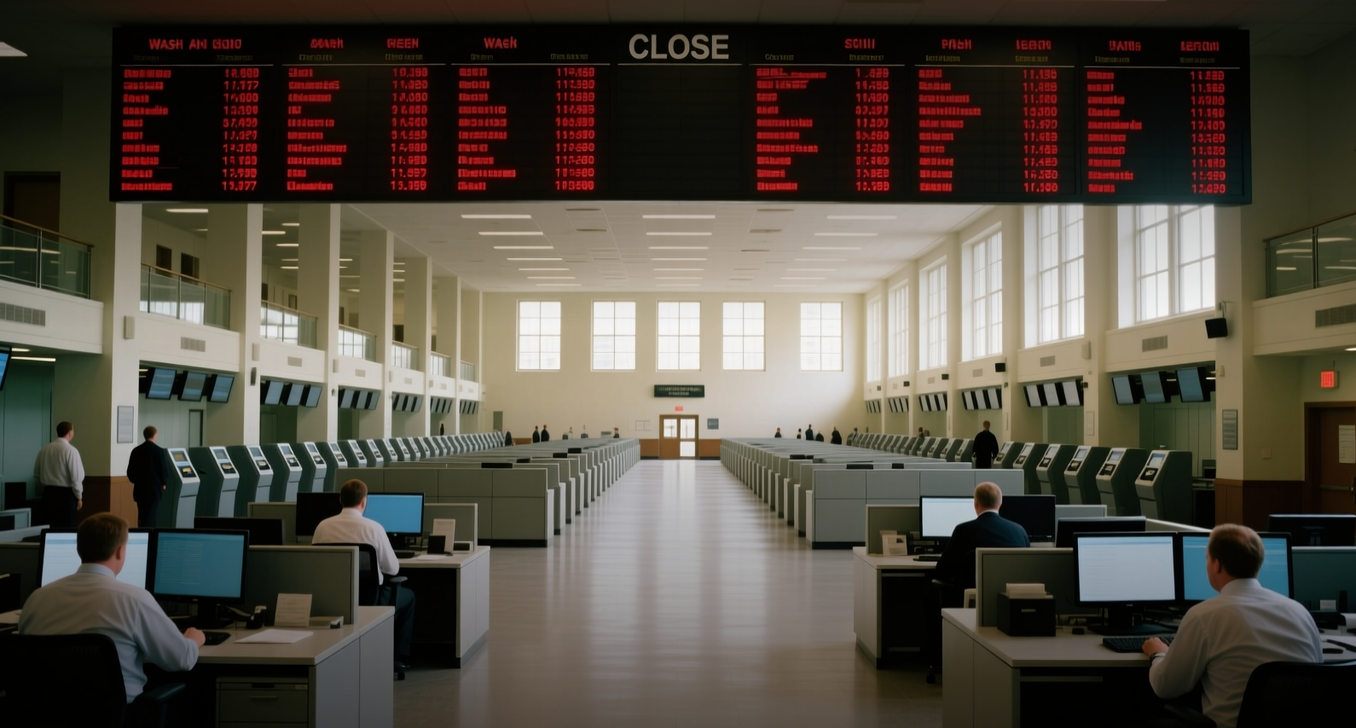
Stocks fell to a two-week low Thursday as rising bond yields and oil prices outweighed Treasury's surprise buyback relief.
The S&P 500 fell 0.9% to 7,642 on Thursday, while the Nasdaq Composite dropped 1% to 26,067 and the Dow Jones Industrial Average lost 1.3% to 52,759. The decline snapped a one-day relief rally after the Treasury announced it would double long-dated bond buybacks to $4 billion per operation starting Sept. 9.
"The 35% probability rate markets are currently putting on a hike next month may be on the low side," said Jamie McGeever, markets columnist at Reuters, citing the Fed's July meeting minutes that showed "several" and "many" officials see a rate hike as likely if inflation doesn't ease.
Nine of 11 S&P 500 sectors fell, led by consumer staples at -2% and consumer discretionary at -1.7%, while energy gained 0.4% as oil climbed 2% to a four-week high. Walmart shares plunged 9%, their biggest drop in four years, after same-store sales growth of 2.6% missed the 3.8% consensus. Moderna dropped 24%, while TJX Companies fell 3% despite beating earnings estimates. The 10-year Treasury yield rose above 4.70%, higher than before the buyback announcement, while the 30-year yield added 5 basis points.
The market faces a convergence of pressures: a Fed weighing a September hike, oil up nearly 40% year-on-year, and U.S. debt crossing $40 trillion for the first time. With the term premium at its highest level in over a decade, investors are questioning whether Treasury's intervention can hold without a broader strategy to address fiscal fundamentals.
Treasury Secretary Scott Bessent's decision to expand long-bond buybacks follows his foray into the FX market to support Japan's yen. The Trump administration has also bought stakes in companies, ordered $200 billion of mortgage-backed securities purchases, and called for a one-year cap on credit card interest rates. Bessent said the long end of the Treasuries curve doesn't reflect "underlying fundamentals," but five years of above-target inflation, near-record deficits, and federal debt above $40 trillion suggest otherwise.
Fed Chair Kevin Warsh has said bond yields are a useful guide for policymakers, creating tension between the Treasury's interventionist approach and the Fed's data-dependent stance. The recent surge in the term premium toward its highest level in over a decade suggests both officials have convincing to do. A 30-year TIPS auction drew the strongest demand since December 2020, with a bid/cover ratio of 2.82, showing investors still see value in inflation-protected paper.
The dollar index ended flat after making a new three-month low, with the euro trading above $1.17 for the first time since May. Bitcoin rose 5%, up 15% this week. Gold climbed above $4,600 per ounce, its third straight weekly gain, as investors sought protection from policy uncertainty.
Overseas, South Korea's KOSPI jumped 6% and Japan's Nikkei gained 1%, while European and UK markets were little changed. Japan's core CPI inflation is expected to accelerate to 1.8% in July from 1.6% in June, with producer prices up over 7% from just 2% in February. Traders price a one-in-three chance of a BOJ hike in September, similar to the Fed. Flash PMI data for the U.S., UK, euro zone, and Japan are due Friday, along with UK and Canada retail sales.
Despite Thursday's pullback, two-thirds of S&P 500 stocks remain positive for 2026, suggesting the equity market's resilience to higher yields may persist as long as earnings growth holds up. The key question for investors is whether the Treasury's interventionist approach can stabilize the long end of the curve without triggering a broader loss of confidence in U.S. fiscal management.
This article is for informational purposes only and does not constitute investment advice.
