
Alibaba's DAMO LiON model caught 15 liver tumors radiologists missed in two months, a result published in Nature Medicine.
Alibaba's DAMO LiON model caught 15 liver tumors radiologists missed in two months, a result published in Nature Medicine.
Alibaba's DAMO LiON model caught 15 liver tumors radiologists missed in two months, a result published in Nature Medicine.
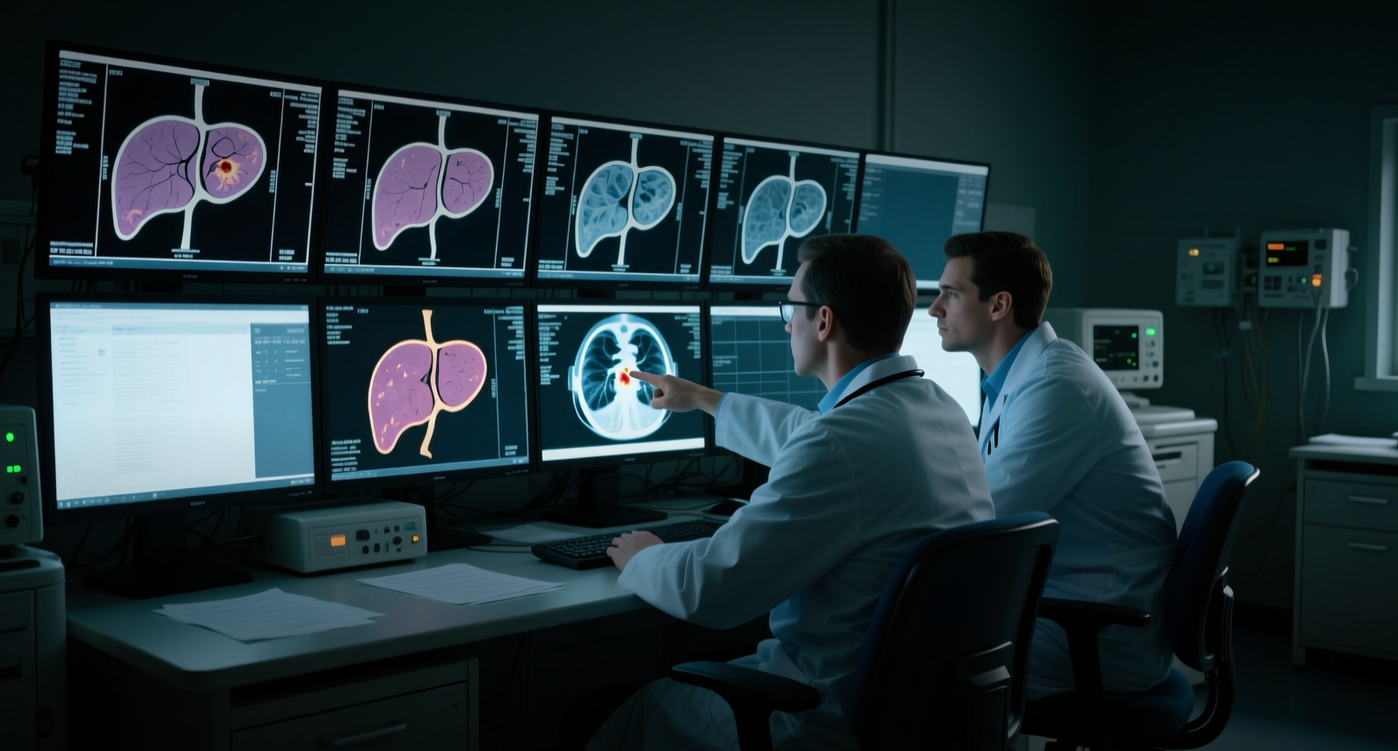
Alibaba's DAMO Academy released a liver cancer AI model that caught 15 tumors radiologists missed in two months, cutting review time 27 percent and sharpening the case for AI-assisted diagnosis.
The model, called DAMO LiON, was built with Shengjing Hospital of China Medical University and acts as an "AI safety officer" that flags subtle lesions on contrast-enhanced CT scans, the research team said. It is designed to catch primary liver cancer and, more critically, the liver metastases that are easy to overlook when a doctor's attention is drawn to the original tumor.
In a real-world prospective trial covering more than 10,000 patients, the model identified 15 malignant tumors that had been missed, most around 1 centimeter across, allowing patients to receive surgery or drug treatment sooner. When doctors used the model to review scans, reading time fell 27 percent and sensitivity to malignant tumors rose 11.5 percent, lifting junior radiologists to the level of senior staff. In one case, the AI flagged a liver metastasis in a 65-year-old bladder cancer patient whose tumor markers were normal and whose initial read showed only calcification, changing the chemotherapy plan.
The result, published in Nature Medicine, strengthens Alibaba's claim to applied AI leadership in China as it funnels billions into the technology. Citi trimmed its price target on Alibaba's Hong Kong-listed shares to HKD189 while calling the company "China's standout AI play," and Alibaba is raising HKD80 billion through a placement to fund AI investment.
Liver cancer and liver metastases are notoriously hard to detect early. Small lesions are easily obscured by cirrhosis, fatty liver, and complex anatomy, and radiologists reading dozens of scans a day can miss a 1-centimeter tumor. DAMO LiON addresses this by balancing the relationship between the lesion and the whole liver while preserving local texture boundaries, and by integrating images from multiple contrast phases to capture fleeting small lesions.
The model's architecture is an improved network that outperformed radiologists on malignant-tumor identification accuracy in the trial, according to the research team. In deployment, when the AI's initial read conflicts with the first assessment, senior doctors review the case, and multidisciplinary discussions are escalated when necessary. That workflow is designed to keep the model as a second reader rather than a replacement, a distinction that matters for regulatory acceptance in clinical settings.
DAMO Academy has worked on medical AI since 2017, expanding from screening to diagnosis. The liver cancer model is one of several clinical tools Alibaba has pushed into hospitals, part of a broader effort to turn its cloud and AI research into revenue-generating healthcare products.
For investors, the question is whether clinical AI becomes a meaningful revenue line for Alibaba or remains a research showcase. The company has not disclosed pricing or commercial terms for DAMO LiON, and medical AI adoption in Chinese hospitals is still early. But the Nature Medicine publication gives Alibaba a credible, peer-reviewed proof point in a field where trust is the main barrier to deployment.
Alibaba's Hong Kong-listed shares, which trade under the ticker 09988.HK, have been supported by its AI narrative as it raises HKD80 billion to fund compute and model development. Citi's HKD189 target implies the market is already pricing in faster cloud growth tied to AI. Whether diagnostic tools like DAMO LiON move the needle depends on whether they convert into hospital contracts and recurring software fees, a path that remains unproven at scale.
This article is for informational purposes only and does not constitute investment advice.
