
The Treasury's surprise doubling of its bond buyback program bought one day of relief before investors resumed selling.
The Treasury's surprise doubling of its bond buyback program bought one day of relief before investors resumed selling.
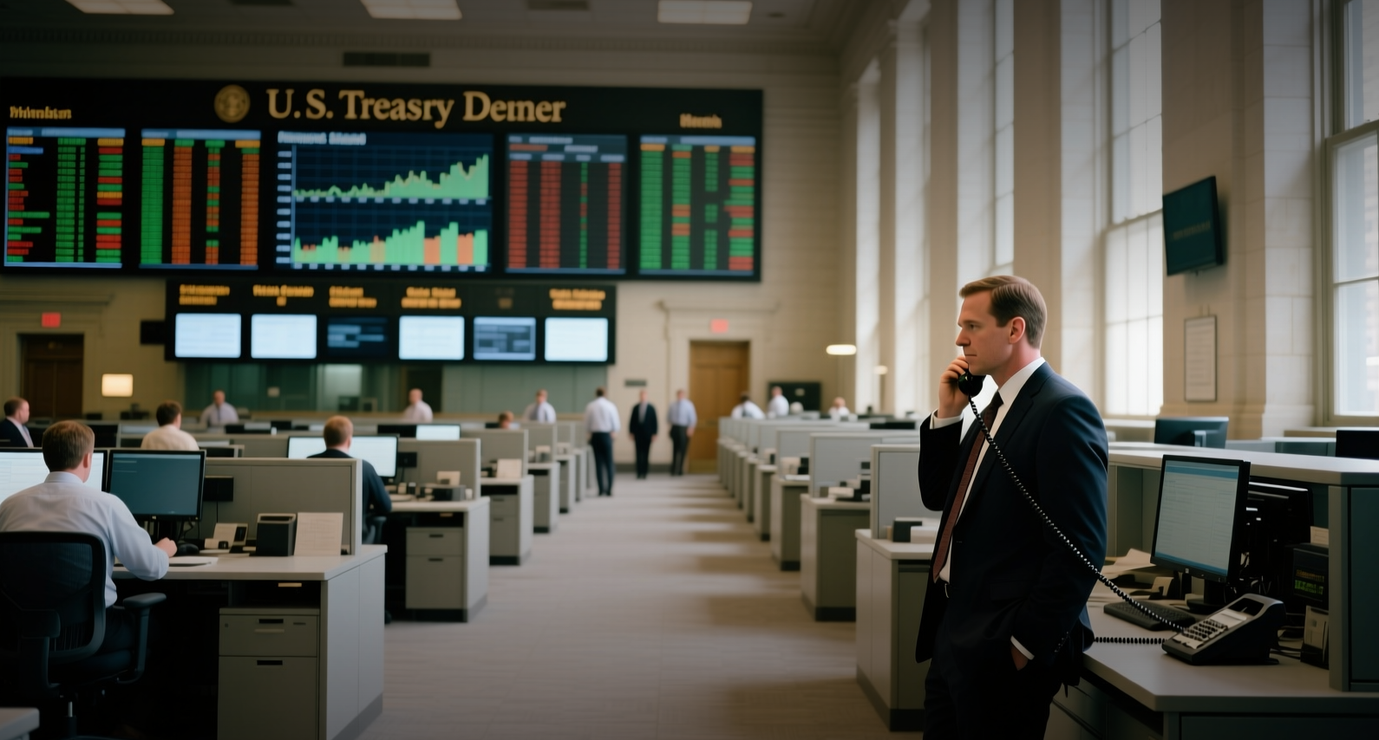
The U.S. Treasury doubled its long-term bond buyback program to at least $4 billion per operation Wednesday, an intervention that briefly steadied a market where the 30-year yield had just touched a 19-year high of 5.34%.
"The buyback can help crowd in potential buyers tempted by the prior run-up in yields and force some near-term short-covering," said Krishna Guha, head of global policy and central bank strategy at Evercore ISI.
The announcement moved markets immediately. The 30-year yield fell 9 basis points to 5.196% and the 10-year dropped 5.7 basis points to 4.647%, while stock futures surged. The relief proved short-lived: by Thursday the 30-year yield was back near 5.24% and the 10-year had ticked up about 5 basis points to 4.704%, with the Dow falling 1.32% and the S&P 500 down 0.87%.
The buyback expansion adds at least $14 billion in capacity this quarter — modest against a $32.2 trillion Treasury market and the $40 trillion national debt that crossed that threshold Wednesday. Whether it tempers volatility or merely delays a reckoning with America's fiscal trajectory will be tested at the next quarterly refunding announcement on Nov. 4.
The program itself is not new. Treasury launched the liquidity support initiative in May 2024 to strengthen market functioning by giving investors a regular mechanism to sell older, off-the-run securities before maturity. It was expanded in 2025, when Treasury repurchased a record $10 billion in a single operation and raised quarterly limits to $38 billion across all maturities. The latest doubling of per-operation sizes, covering 10-to-20-year and 20-to-30-year securities from Sept. 9 through Nov. 4, accelerates that effort.
Economists cautioned the buyback treats a symptom rather than the underlying disease. Mohamed El-Erian said on X that the planned purchases are "small in both absolute terms and relative to net issuance" and represent a broader deployment of yield curve control. Evercore analysts added the operation "changes almost nothing in terms of the fundamentals — in particular the unchanged need to finance the tidal wave of hyperscaler debt in addition to very large government deficits."
The bond market's distress reflects multiple pressures converging on U.S. government debt. Rising term premiums — the extra yield investors demand to hold longer-duration bonds — have widened. Traditional foreign holders have reduced exposure, corporate debt supply has swelled, particularly from artificial intelligence companies raising capital, and geopolitical uncertainty over the U.S.-Iran conflict has driven risk-off positioning that pushed the 30-year yield to its highest since 2007. Oil prices have surged as Washington prepares an "economic D-day" initiative to restrict Iran's economy, adding an inflation premium that Rabobank analysts note has pushed the 5y5y U.S. inflation swap forward close to its May peak even as headline inflation has fallen.
Bessent defended the move as a liquidity tool rather than an attempt to cap yields, telling CNBC the 30-year segment was "extremely weak" during a sparse summer period marked by heavy corporate supply. He said the Treasury has a broad set of instruments and that current yield levels do not align with the underlying economic picture, calling the Iran conflict a transient factor. On fiscal matters, he said he and White House budget chief Russell Vought would soon unveil a deficit-reduction initiative, citing an anti-fraud task force and cuts to state grant programs as possible avenues for several hundred billion dollars in savings. The July deficit reached $432 billion, the highest in more than five years.
Thomas Simons, chief U.S. economist at Jefferies, said the surprise announcement upends Treasury's tradition of consistent, predictable communications about debt issuance, adding the move feels "shot from the hip." Still, Anshul Sharma, chief investment officer at Savvy Wealth, argued the intervention shows resolve: "This doesn't solve the underlying issues around deficits, inflation, or Treasury supply. But it buys some time and, perhaps more importantly, signals that Treasury has tools available and is willing to use them when market conditions warrant." The buyback expansion remains in effect through the next quarterly refunding announcement on Nov. 4, when investors will learn whether the doubled capacity is enough — or whether the selloff resumes.
This article is for informational purposes only and does not constitute investment advice.
