
The Swiss bank now projects quarter-point rate increases at the September and December FOMC meetings, abandoning its prior view of no policy moves in 2026 after the August employment report showed 162,000 new jobs.
The Swiss bank now projects quarter-point rate increases at the September and December FOMC meetings, abandoning its prior view of no policy moves in 2026 after the August employment report showed 162,000 new jobs.
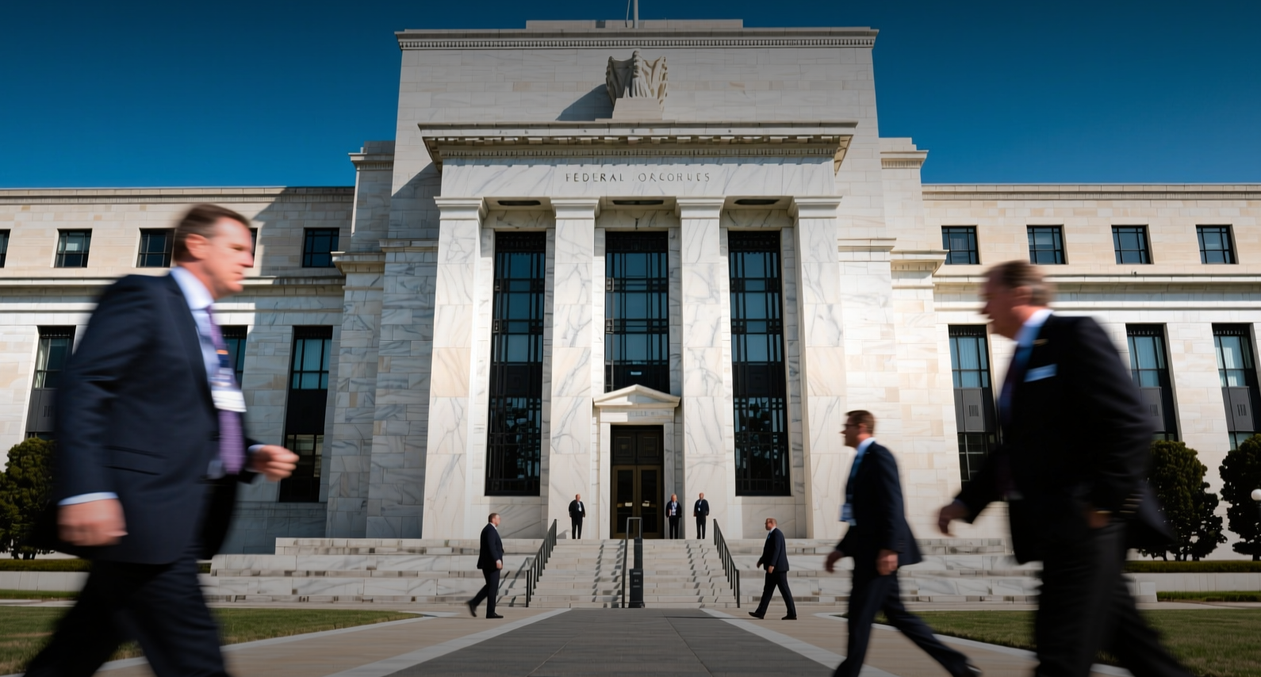
UBS now expects the Federal Reserve to raise rates by 25 basis points in September and December, reversing its no-change call after August payrolls tripled forecasts.
The Swiss bank's revised outlook follows a Labor Department report showing nonfarm payrolls rose 162,000 in August, nearly three times the 55,000 consensus estimate in a Bloomberg survey. The unemployment rate held at 4.1 percent, while average hourly earnings rose 3.1 percent from a year earlier — still below the 3.7 percent headline inflation rate.
"The report favors Fed hawks because it removes labor market weakness as an immediate concern," said Andrew Hollenhorst, chief U.S. economist at Citigroup. Stephen Brown, chief North America economist at Capital Economics, said only a weak inflation reading would now make it easier to justify leaving rates unchanged.
Treasury yields jumped after the data, with the policy-sensitive two-year yield climbing about 7.6 basis points to 4.41 percent and the benchmark 10-year yield advancing roughly 3.2 basis points to 4.79 percent. Futures traders lifted the implied probability of a September rate increase to about 60 percent from 50 percent. Equities fell as higher-for-longer rate expectations weighed on valuations: the S&P 500 dropped 0.4 percent to 7,719, the Dow Jones Industrial Average lost 0.5 percent to 53,414, and the Nasdaq Composite slipped 0.3 percent to 26,507. The U.S. dollar gained about 0.2 percent against a basket of major peers, while gold fell 1.38 percent to near $4,410 an ounce as higher yields reduced the appeal of non-yielding bullion.
The UBS revision marks a notable shift among institutional forecasters. The bank had previously projected no policy changes in 2026, but the August jobs report — which showed hiring accelerating from July's upwardly revised 21,000 gain — convinced its economists that the labor market remains too strong for the Fed to hold steady. July payrolls were initially reported as a 23,000 decline before being revised higher. The August gain also exceeded the 12-month average of 31,000 jobs per month, with food services and local government education among the leading contributors.
The stakes for the September 16 Federal Open Market Committee meeting are now elevated. Fed Chair Kevin Warsh has said the labor market remains strong, and officials are due to review the August consumer price index report before the vote. Fed Governor Christopher Waller said he is inclined to hold borrowing costs steady if inflation data improve in the coming weeks, pointing to divisions within the committee.
Inflation remains the central constraint. The headline personal consumption expenditures measure ran at 3.7 percent in July, well above the Fed's 2 percent target. Rising energy costs add to the pressure: diesel prices reached a record national average of $5.85 per gallon, surpassing their previous 2022 high, while Brent crude traded near $95 a barrel and West Texas Intermediate hovered around $90.55.
Bank of America said the jobs report largely reversed the decline in September hike pricing that followed Waller's dovish comments on Thursday. The bank added that if August core PCE inflation comes in at 0.24 percent month over month or higher, the odds of a September hike could move above 50 percent. Holding rates steady despite elevated hike expectations could raise questions about the Fed's credibility and push longer-term Treasury yields higher, the bank said.
For investors, the UBS forecast points to a more hawkish macro environment than previously anticipated. Rate hikes typically tighten financial conditions, potentially pressuring growth stocks and high-valuation equities while benefiting financials and value sectors. The next data point to watch is the August CPI report, due before the Fed's September 16 decision, which will determine whether the market's 60 percent hike probability holds or fades.
This article is for informational purposes only and does not constitute investment advice.
