

Waymo brings robotaxis to Munich by late 2027, betting Germany's Level 4 law beats London's regulatory maze.
Waymo brings robotaxis to Munich by late 2027, betting Germany's Level 4 law beats London's regulatory maze.
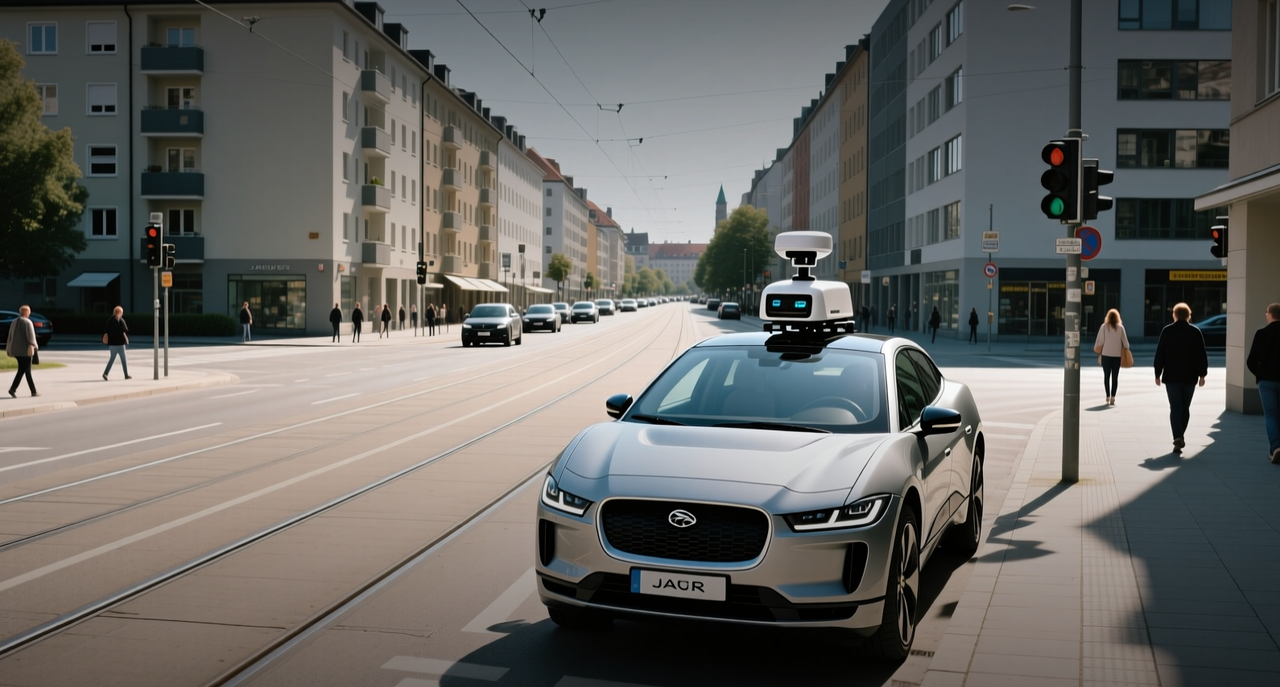
Waymo's Munich entry makes Germany its first EU robotaxi market, targeting commercial service by late 2027 backed by $16 billion raised at a $126 billion valuation.
"Munich is a world-class hub for mobility and engineering, and becoming part of this city marks an important milestone in our global expansion," Tekedra Mawakana, Waymo's co-chief executive, said.
Waymo will deploy a small fleet of all-electric Jaguar I-PACE vehicles in Munich, first driving manually to build high-definition maps of the Bavarian capital's street network, then transitioning to supervised autonomous testing with trained specialists behind the wheel. The company has completed more than 20 million trips and serves over 500,000 paid rides weekly across 11 US cities. Its safety record, drawn from more than 350 million fully autonomous kilometers, shows 16 times fewer serious injury crashes than human drivers and 14 times fewer pedestrian injury crashes.
The Munich expansion lands as competition in Europe's robotaxi market accelerates. Uber, Verne and Pony.ai launched autonomous rides in Zagreb last week, the first European city where users can book a self-driving vehicle through Uber's app. Amazon-owned Zoox has begun deploying its purpose-built driverless vehicles in San Francisco, challenging Waymo on its home turf. Alphabet shares fell 0.44 percent during Tuesday US trading.
Germany passed the world's first legal framework for commercializing Level 4 autonomous vehicles in 2021, yet no domestic company has used it to operate a driverless fleet at scale. That regulatory head start is precisely what drew Waymo to Munich, according to Christian Hirte, parliamentary state secretary at Germany's Federal Ministry of Transport.
"Waymo, the world's leading provider of commercial robotaxi services, has now recognized Germany's potential as a location offering legal certainty," Hirte said in a statement released through Waymo's announcement. He added that Waymo "is currently planning to start regular commercial operation of autonomous vehicles on the German market for the first time."
The federal welcome came with a caveat. "Our goal must be to ensure that we in Europe not only use these technologies but also develop and operate them here," Hirte said.
Bavaria's state government wants faster deployment. Florian Herrmann, head of the Bavarian State Chancellery, said the state will "cut red tape and remove regulatory barriers" to move from testing to real-world deployment quickly.
Waymo's Munich timeline — roughly 14 months from mapping to commercial service — mirrors the runway it set for London in October 2025. But London has not launched. About 100 Jaguar I-PACEs have been testing across 100 square miles and 19 boroughs since spring, with safety operators aboard throughout. Transport for London warned in April that no autonomous vehicle currently meets its standards, and a July freedom of information response confirmed the agency was still developing its approach.
Germany's 2021 legislation permitting Level 4 operation in defined areas gives Waymo a clearer regulatory path in Munich. The company registered Waymo Germany GmbH in June, listing Google's Munich office as its address, and has since registered subsidiaries in France, Spain, the Netherlands and Switzerland.
Munich is becoming a contested proving ground. Uber and AI company Autobrains Technologies announced a partnership in June to develop robotaxi services in the city. British startup Wayve Technologies is conducting technical validation in Germany. Volkswagen's MOIA unit is deploying autonomous ID. Buzz shuttles in Hamburg.
Waymo's financial position gives it room to outlast competitors. The $16 billion raised earlier this year at a $126 billion valuation funds the capital-intensive work of mapping new cities, deploying fleets and navigating regulatory processes across multiple jurisdictions simultaneously. The company plans to add 20 new service locations globally, with London and Tokyo among the next targets.
For German consumers and regulators, Waymo's arrival is a closely watched test case. The country's strict safety and liability standards will determine whether the company's accumulated experience in Phoenix and San Francisco can compress the deployment timeline in Europe. If Munich succeeds, it could set a template for other European cities weighing similar services.
This article is for informational purposes only and does not constitute investment advice.
