
Key Takeaways: Capital-spending booms rarely end when investors expect them to — and the AI buildout has yet to approach the historical danger zone.
Key Takeaways: Capital-spending booms rarely end when investors expect them to — and the AI buildout has yet to approach the historical danger zone.
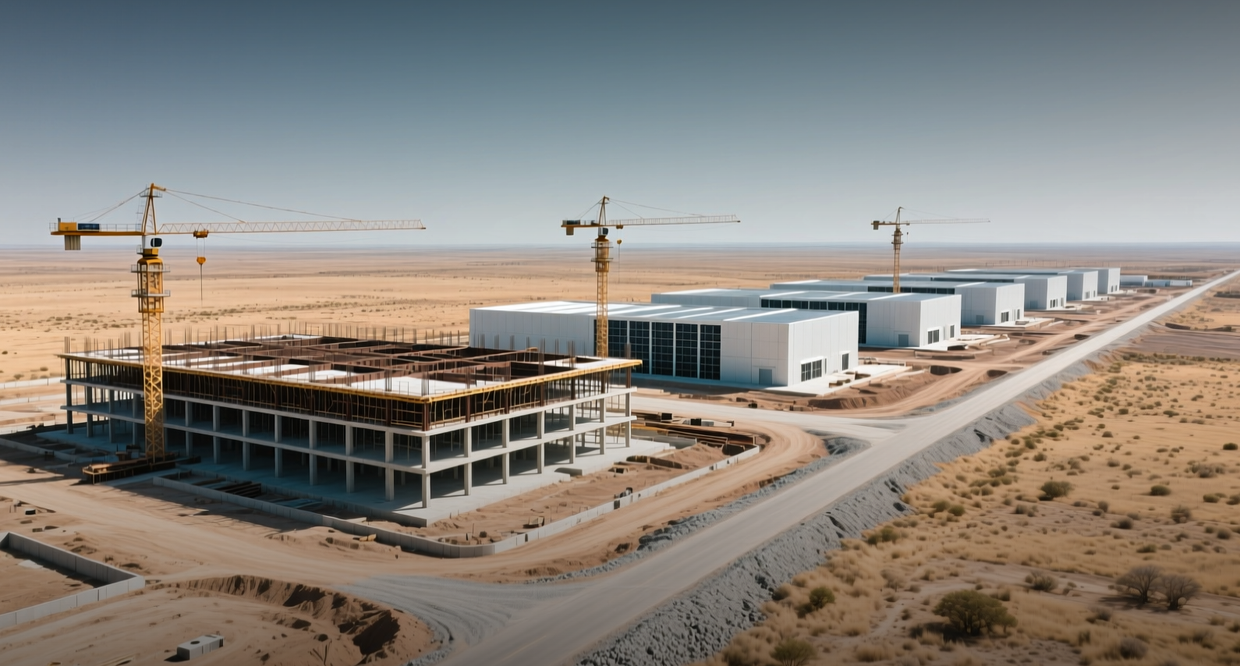
Capital-spending booms rarely end when investors expect them to — and the AI buildout has yet to approach the historical danger zone.
The AI buildout has absorbed roughly $1.15 trillion since early 2024, yet cumulative spending remains far below the 25 percent of GDP threshold that preceded past boom collapses, Barron's analysis of 250 years shows.
"I think we're going to keep going. This is going to be bigger and last longer than anyone expects," Ben Reitzes, head of technology research at Melius Research, said.
Since early 2024, companies have poured about $500 billion into chips, $350 billion into power infrastructure, $200 billion into construction and $100 billion into networking equipment — a total exceeding the roughly $575 billion the entire S&P 500 spent on capital projects in 2021, the year before OpenAI released ChatGPT. Amazon, Alphabet, Meta Platforms and Microsoft plan roughly $2 trillion in combined spending over the next two years, with FactSet consensus pegging 2027 capex near $960 billion against projected operating cash flow of about $905 billion.
The "Rule of 25" — the share of economic output the U.S. has historically absorbed before a capital boom turns dangerous — puts the theoretical danger zone near $7.5 trillion in cumulative domestic investment against a roughly $30 trillion economy. Current spending sits well below that level, suggesting the cycle may run for years even as AI stocks have fallen 20 percent from June highs and the cost of insuring hyperscaler debt has climbed.
Financing the next trillion
The most important shift in the AI trade is happening away from the stock market. Big Tech's earliest data centers were largely funded from internal cash flow; the next several trillion dollars will lean more heavily on external capital. J.P. Morgan Securities analyst Tarek Hamid estimates more than $5 trillion could be invested in AI data centers between 2026 and 2030, with roughly $1.5 trillion coming from cash flow and the rest from credit markets, new equity and alternative structures.
The strain is already visible in the numbers. Meta's free cash flow plunged 91 percent year over year in the second quarter as capex jumped 88 percent to $31.1 billion. Alphabet posted its first-ever quarter of cash outflows since going public in 2004 after capex doubled to $44.9 billion. Amazon swung to a negative $8.8 billion in free cash flow as capex rose 68 percent to $54.21 billion. Microsoft, the relative standout, saw free cash flow fall 23 percent to $19.6 billion despite capex more than doubling.
The four hyperscalers have become major borrowers. Alphabet's long-term debt stood near $115 billion at the end of June, more than tripling from a year earlier, after it sold a $25 billion senior note, tapped the Australian market for $3.6 billion and issued a rare 100-year sterling bond. Amazon ended June with $222 billion in long-term debt, up 67 percent, while Meta's $110 billion was up 131 percent. Microsoft has avoided bond sales since 2024 but signed significant long-term data-center leases that count as liabilities.
Companies are also turning to off-balance-sheet structures. Meta's venture with BlackRock to build a roughly $14 billion data-center campus in El Paso, Texas, leaves BlackRock owning 80 percent and Meta leasing the capacity. Meta has a similar joint venture with Blue Owl Capital for its "Hyperion" facility in Louisiana, and its future lease commitments ballooned from about $180 billion to roughly $280 billion in one quarter. Nvidia has partnered with Wall Street firms to mobilize $500 billion in third-party capital, while Broadcom launched a funding platform with Apollo and Blackstone.
Who wins, who loses
Credit analysts are watching the balance-sheet strain closely. S&P Global downgraded Oracle in July to BBB-, the lowest tier of investment grade, citing "material credit risks" from aggressive spending and an uncertain path to positive cash flow. Oracle has posted negative free cash flow for five straight quarters. Among the four largest hyperscalers, S&P rates Microsoft AAA, Alphabet AA+, Amazon AA and Meta AA-, with Meta's ballooning lease commitments flagged as a concern.
The boom can continue while producing both winners and casualties. A hyperscaler can spread the same infrastructure across cloud, advertising, search and productivity software, while a specialized provider with a concentrated customer base has fewer ways to absorb excess capacity. The next stage of the buildout is expanding beyond graphics processors into memory, networking, power distribution, cooling and transformers, broadening the beneficiary list to companies such as Amphenol, TE Connectivity, Eaton and Vertiv.
The clearest threat is a sustained rise in long-term interest rates. Higher Treasury yields reduce the present value of future cash flows from multibillion-dollar facilities and compress the elevated earnings multiples many AI-linked stocks carry. Barclays analysts wrote in an Aug. 13 note that the hyperscaler industry has "natural limits around debt levels and power agreements" that it appears to be approaching in 2027.
For investors, the question is less whether the boom ends than when — and which companies survive the shakeout. Wall Street broadly expects an inflection in AI returns around 2028, according to S&P Global's Naveen Sarma; if revenue fails to catch up with spending, credit issues would follow. The more durable strategy, analysts say, is to favor companies with approved projects, reliable customers and strong balance sheets over those announcing ambitious plans without secured power, land or contracts.
This article is for informational purposes only and does not constitute investment advice.
