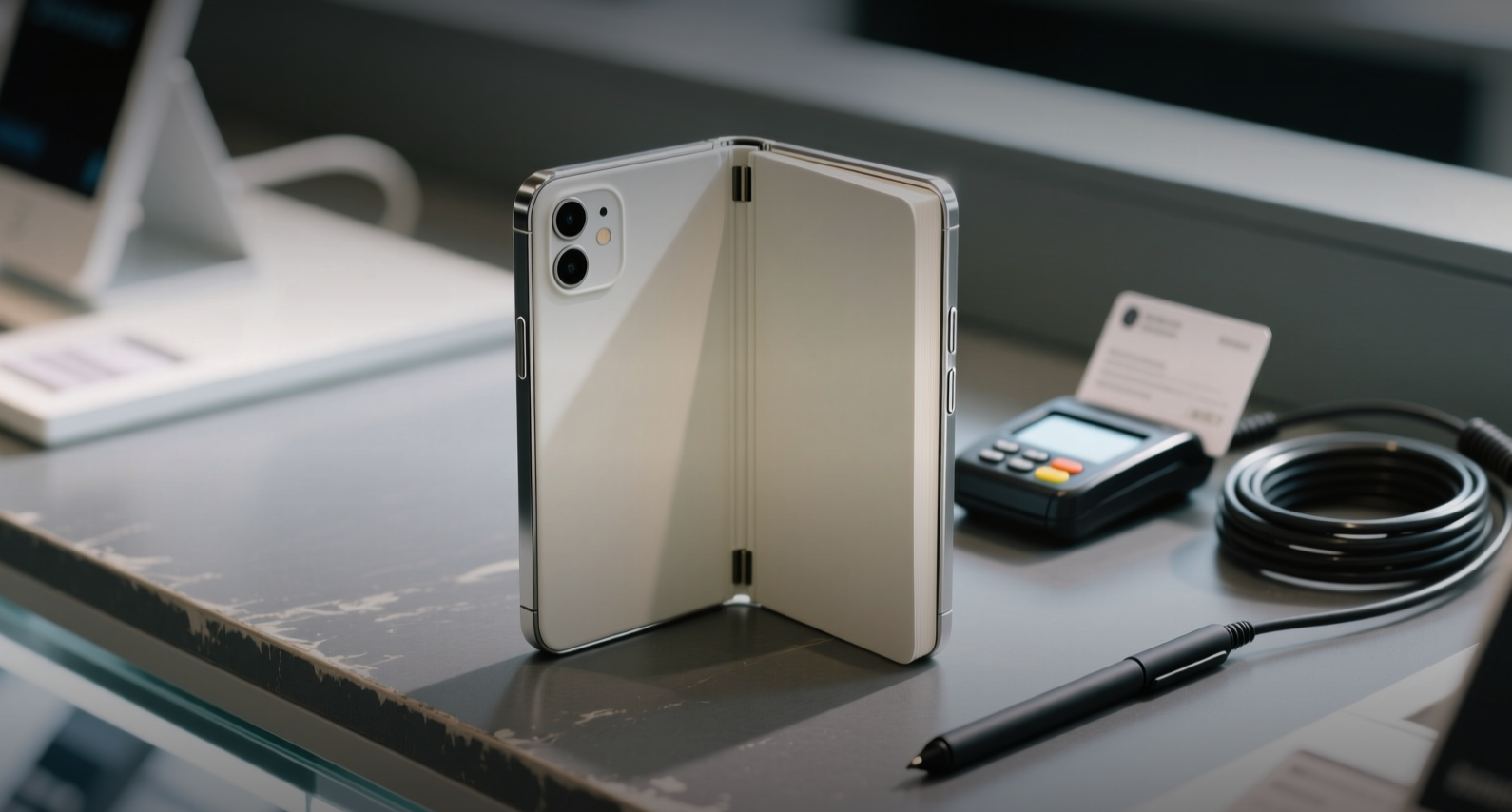
Apple priced its first foldable phone at $1,999, betting that a 7.6-inch book-style handset can pull premium buyers away from Samsung, which has sold folding devices since 2019.
"Others have created a foldable that feels like two phones awkwardly stuck together," CEO John Ternus said at the company's "Surprise and Shine" event in Cupertino on Sept. 9, adding that the iPhone Duo will "redesign the experience of using a foldable phone."
The Duo opens to a 7.6-inch internal display and closes to a 5.4-inch outer screen, giving it 80% more screen area than Apple's latest iPhone Pro, according to the company. It is the thinnest iPhone ever when unfolded, carries an IP68 dust- and water-resistance rating that Samsung's Galaxy Z Fold8 lacks, and ships with iOS 27.1. Pre-orders begin Oct. 16, with retail availability Oct. 23. Apple also raised the entry price of the iPhone 18 Pro to $1,199, a $100 increase, and discontinued the iPhone 17 Pro and Pro Max.
Samsung answered within hours. A company spokesperson told CNBC that the share of global users switching from iOS to its Galaxy Z Fold8 series, launched in July, ran 1.6 times higher than for the prior-generation Fold7 and Flip7. Samsung added that 30% of US buyers of the Galaxy Z Flip8 came from other smartphone brands, most of them buying a foldable for the first time.
The category is still small enough that share math cuts both ways
Foldables account for roughly 2% of worldwide smartphone sales, according to Jason Snell, who writes about Apple at Six Colors. That figure is the hinge on which the whole competitive argument turns. Apple can take a large slice of a tiny pie and still move its revenue line only marginally, while Samsung can lose relative share without losing meaningful volume.
"Folding phones are a solid category, but they're not a huge category," Snell said. "I think Apple will do a lot to popularize it, but even so, I think it's a niche product, and if it's the future of the smartphone, it's probably the far future."
The Duo's $1,999 starting price sits $700 above the entry iPhone 18 Pro and roughly in line with Samsung's Galaxy Z Fold8 Ultra tier. Apple is also charging separately for accessories: the Duo works only with the $79 USB-C Apple Pencil, not the Apple Pencil Pro, and requires its own case and folio. The device ships in two finishes, Star White and Night Sky.
Component economics favor whoever sells the most units. Foldable bill-of-materials costs are dominated by the hinge assembly and flexible OLED panel, both of which carry thinner margins at low volumes. Apple's scale in display procurement, built through its iPhone and iPad lines, gives it more room to absorb those costs than Samsung's foldable-only volume — but only if the Duo clears the 2% category ceiling that has capped the segment for seven years.
Ternus gets a hardware statement, and a harder comparison
The launch was Ternus's first keynote since taking over from Tim Cook on Sept. 1, after 25 years at Apple. Cook grew Apple's market cap nearly 13-fold during his tenure but drew criticism that the product line lost the design ambition of the Steve Jobs era. Ternus, a mechanical engineer who spent most of his career on the product side, used the Jobs line — "there is one more thing" — to introduce the Duo.
Apple shares have risen 22% over the past six months, outpacing the S&P 500's 13% gain over the same period, a run that leaves less room for a product misstep. The Duo's success also depends on software: Apple pledged a beta of iOS 27 in October with an AI-enabled Siri that can reach users' contacts, calendar, messages and email, positioning the phone as an on-device intelligence hub rather than a cloud-dependent assistant.
Forrester vice president Dipanjan Chatterjee said Apple is betting Siri "can become an invisible intelligence layer connecting context, personalization, and privacy across the ecosystem. Apple has spent years promising a smarter Siri. Now the bill has come due."
The risk is demand, not engineering. Freelance tech writer Philip Michaels pointed to rising memory chip prices and flat wages as the constraint on a $1,999 purchase whose headline features are largely software. Apple's own price increases across the iPhone 16, 17 and Air lines this week reinforce that pressure.
Samsung's switching data suggests the near-term churn runs in its favor, not Apple's — at least until the Duo reaches shelves on Oct. 23. The number to watch is whether Apple's entry expands the 2% foldable share of the overall market, which would lift both companies, or simply redistributes it.
This article is for informational purposes only and does not constitute investment advice.