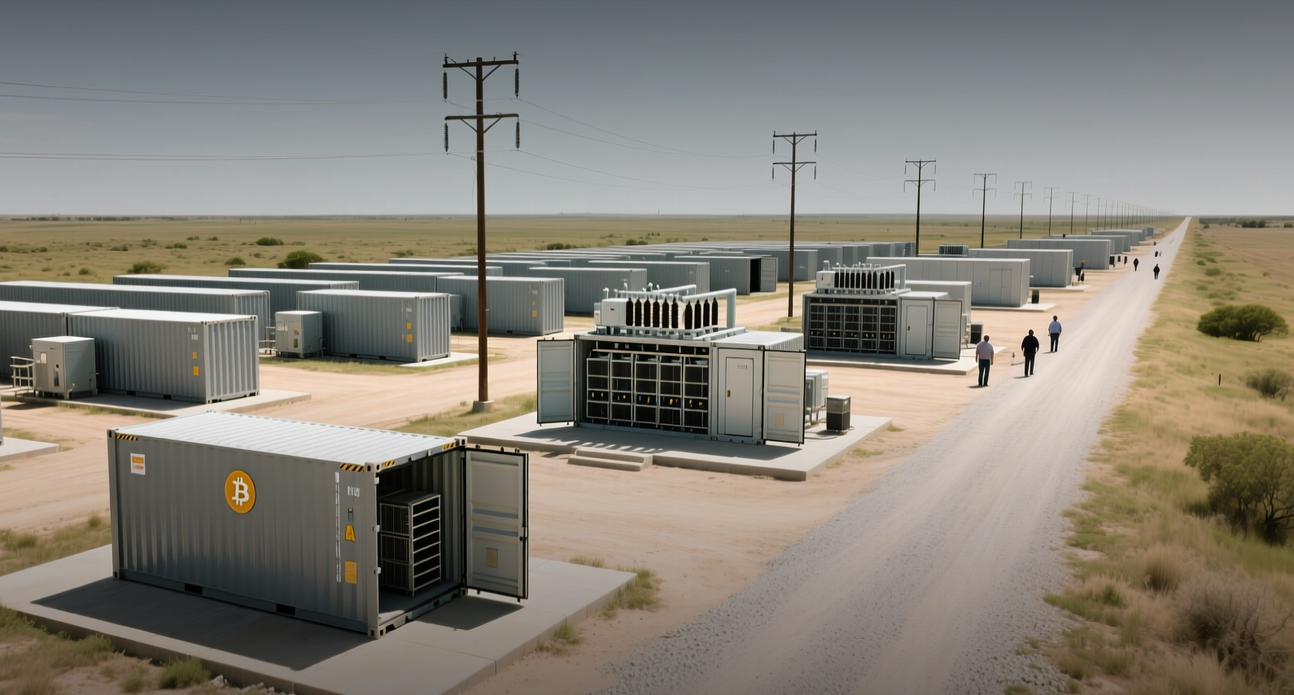
CoinShares data published Sept. 10 shows the revenue gap between hosting artificial-intelligence workloads and hashing Bitcoin has widened enough that public miners are now reallocating contracted power at scale, compressing mining margins even as US network computing power keeps rising.
"Miners are making a capital-allocation decision, not a sentiment call," Nina Volkov, a Bitcoin macro analyst covering miner economics, said. "When a megawatt earns more hosting inference than it does hashing, the hash rate stops being the metric that matters and the power contract becomes the asset."
The spread is visible in the contract book. Publicly traded miners have signed AI and high-performance computing hosting agreements totaling between $70 billion and $90 billion, according to company disclosures compiled by industry trackers, with some operators projecting AI could reach 70% of revenue by the end of 2026. Bitcoin miners control more than 27 GW of planned power capacity across the US, much of it in Texas where grid interconnections are already built — a queue position that new AI entrants can wait years to obtain.
Network data shows the reallocation is already moving the hash rate. Bitcoin's computing power fell from a peak above 1.14 ZH/s in October 2025 to a range of 868 to 900 EH/s by mid-to-late 2026, a decline of roughly 15% to 21%, before rebounding to 915 EH/s on Sept. 8 after a third defense of the 850 EH/s zone, per Coin Edition. The network has now spent more than 300 days below its record high.
The offsetting force is difficulty. As hash rate fell, Bitcoin's automatic adjustment cut mining difficulty, letting remaining operators capture a larger share of block rewards with the same machines. Hashprice has recovered toward $40 per PH per day, up more than 22% from prior levels, which reduces the pressure that forces operators to shut rigs down or sell coins to cover electricity bills.
That recovery is the crux of the near-term margin question. Rising hash rate alongside rising hashprice means miners can expand without added financial stress; rising hash rate alongside falling hashprice would renew the squeeze. The current combination — a hash rate 20% below peak and a hashprice climbing off the floor — reads as stabilization rather than a directional signal for Bitcoin's price.
The funding gap is the real constraint
Execution, not intent, is what separates the miners that capture the AI spread from those that merely announce it. VanEck estimates a $50 billion near-term funding gap for miners attempting to convert operations to AI workloads, and only about 25% of leased capacity has actually been delivered so far. Hyperscale Data suspended mining at its Michigan facility in September 2026 to pursue a potential $1.2 billion AI contract — a clean illustration of the trade, and of the revenue hole a miner accepts while the contract ramps.
Regulation adds friction at the state level. New York has imposed a moratorium on new or expanding data centers exceeding 50 megawatts, which blocks pivots inside the state and pushes capacity toward Texas, Ohio and the Southeast.
Equity analysts have started pricing the power pipeline rather than the hash rate. Morgan Stanley initiated Overweight ratings on Hut 8 and Riot Platforms, citing power access as the competitive advantage, a re-rating that treats these companies closer to data-center landlords than to Bitcoin producers. Cipher Mining's Sept. 8 announcement of a 2.5 GW natural gas power strategy drew a sharp rally followed by a pullback as analysts questioned the valuation, and IREN's 2 GW Sweetwater Hub in Texas was accepted as "Base Load" in ERCOT's Batch Zero process — a regulatory milestone that de-risks its AI buildout and reinforces the same read-through.
The concentration risk runs the other way. If more operators abandon hashing for hosting, the remaining hash rate consolidates among fewer participants, a structural shift worth monitoring for anyone tracking Bitcoin's decentralization metrics. The next hard data points are the difficulty adjustment and the monthly hashprice prints, which will show whether the Sept. 8 rebound holds or whether the 850 EH/s zone gets tested a fourth time.
This article is for informational purposes only and does not constitute investment advice.