


Northrop Grumman Corp. is running on a wartime footing as the Pentagon accelerates weapons procurement under the Trump administration's $1.5 trillion defense budget proposal.
Northrop Grumman Corp. is running on a wartime footing as the Pentagon accelerates weapons procurement under the Trump administration's $1.5 trillion defense budget proposal.
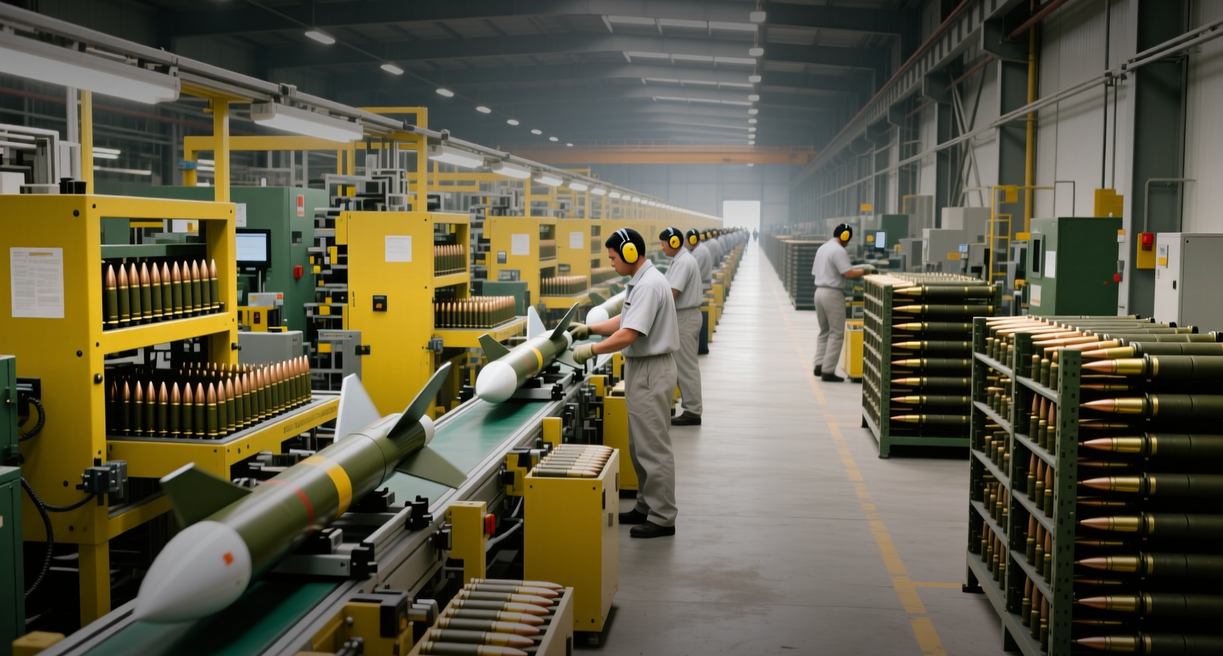
Northrop Grumman Corp. is operating on a wartime footing as it supports US military operations across multiple theaters, Chair and CEO Kathy Warden said Tuesday, a posture that reflects the scale of the Trump administration's $1.5 trillion defense budget proposal.
"We are on a wartime footing," Warden said at a Bloomberg Newsmakers event in Washington, describing the contractor's support for the administration's efforts around the world.
The declaration comes nearly six months into the US-Iran conflict, which began with joint US-Israeli strikes on Feb. 28. The Pentagon has since signed multiyear contracts with defense contractors to expand production of advanced munitions, with Defense Secretary Pete Hegseth describing the effort as a "generational investment of 2X, 3X, 4X war munitions."
The wartime posture carries direct financial implications. Trump's proposed $1.5 trillion defense budget would mark a substantial increase over current Pentagon spending, and Northrop Grumman — alongside peers Lockheed Martin Corp. and RTX Corp. — stands to capture a significant share of the expanded procurement pipeline. The company's B-21 bomber program and missile defense portfolio position it as a primary beneficiary of sustained conflict-driven demand.
The conflict has already tested US munitions stockpiles. The USS Abraham Lincoln aircraft carrier completed a deployment of more than 270 days in the Middle East, with Hegseth acknowledging the mission was "tough" and longer than most. External analysts have pointed to a critical shortfall of advanced weapons that take years to replace, though Hegseth denied the US faces a munitions shortage, saying "we had plenty when we needed it, we have plenty now."
The Strait of Hormuz remains the primary flashpoint, with Iran demanding the lifting of the US naval blockade and war reparations as conditions for reopening the waterway that handles roughly 21 percent of global oil trade. The US said all mines have been cleared from the strait, but attacks on commercial shipping continue — a tanker was struck by an unknown projectile off the coast of Oman this week, disabling its engine room.
Northrop Grumman's backlog — which includes the B-21 Raider bomber, the Sentinel intercontinental ballistic missile program, and advanced missile defense systems — has grown as the Pentagon prioritizes strategic deterrence. The company's position as a prime contractor on multiple high-priority programs gives it unusual visibility into the administration's procurement plans.
Defense Budget Faces Congressional Test
The $1.5 trillion proposal faces an uncertain path through Congress, where lawmakers have raised concerns about the fiscal impact. Hegseth said the Pentagon will proceed with efforts to boost weapons production even if Congress fails to approve the full budget, noting that multiyear deals with contractors are already in place. The last comparable surge in defense spending occurred after the Sept. 11 attacks, when the Pentagon's base budget roughly doubled between 2001 and 2010 — a precedent that suggests the current cycle could sustain contractor backlogs for years.
Iran Sanctions Add Economic Pressure
The military posture is paired with an aggressive economic campaign. Treasury Secretary Scott Bessent announced "Operation Economic Outcast" on Monday, expanding secondary sanctions across five sectors — digital assets, technology, gold, aviation and shipping — targeting nearly 60 entities, individuals and vessels connected to Iranian oil networks, cyber operations and procurement schemes. Iran's currency has fallen to a record low of 2.02 million rials per dollar, and the IMF projects the economy will contract by more than 5 percent this year.
For investors, the wartime footing declaration from Northrop Grumman's CEO is the clearest signal yet that defense contractors expect elevated demand to persist beyond the current conflict. With the Pentagon pushing for a multi-year munitions buildup and Congress yet to weigh in on the full budget request, the sector's earnings trajectory will hinge on whether procurement commitments translate into sustained order flow through 2027 and beyond.
This article is for informational purposes only and does not constitute investment advice.
