
NScale's $71 billion Monarch Compute Campus in West Virginia is set to become one of the largest computing hubs in the world.
NScale's $71 billion Monarch Compute Campus in West Virginia is set to become one of the largest computing hubs in the world.
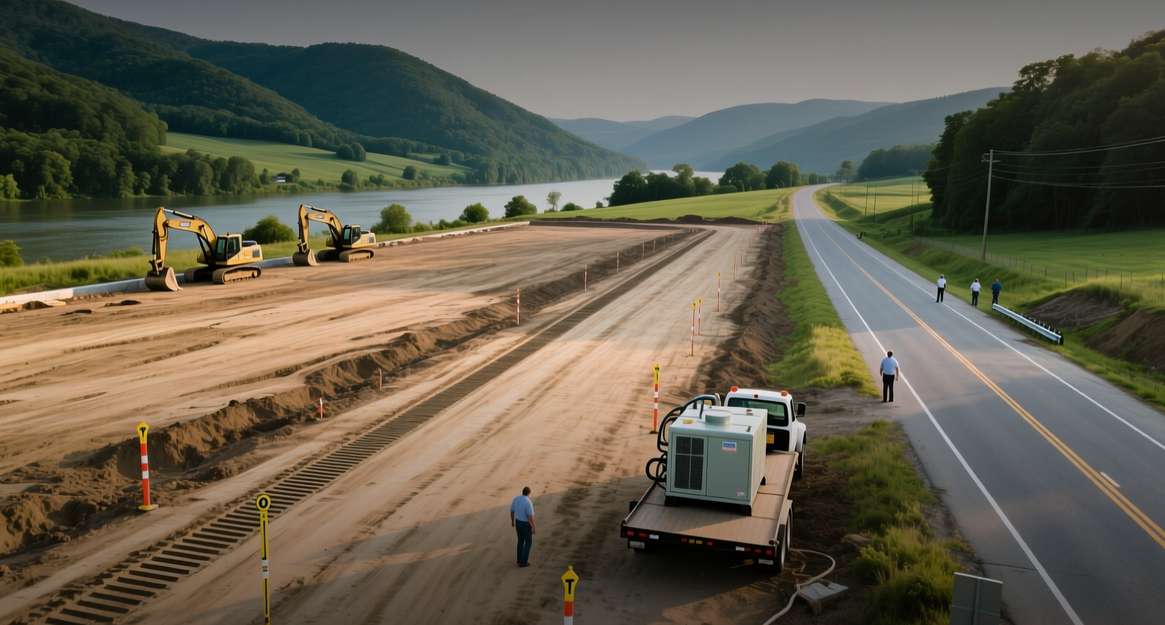
NScale plans to invest $71 billion to build the Monarch Compute Campus in Mason County, West Virginia, a data center complex that will rank among the largest computing hubs globally when fully operational.
"Demand for people trained in STEM and the skilled trades has never been higher," NScale CEO Josh Payne said. "This gift will help Mason County students access the tools and training necessary to succeed in a technology-first economy."
The campus, located along W.Va. 62 north of Point Pleasant, will feature four H-shaped buildings powered by natural gas generators. Site preparation began in April, with the first phase scheduled for completion in early 2028 and a second phase to follow. NScale expects the campus to be in operation by January 2027. The company has not yet disclosed the campus's total power capacity in megawatts.
An EY economic analysis projects the construction phase will create 6,250 jobs and contribute $3.9 billion to Mason County's gross domestic product. Once operational, the campus will support 2,090 permanent jobs in the county and generate $105 million in annual property taxes.
The investment represents one of the largest single-state corporate commitments in U.S. history, placing NScale alongside hyperscalers like Microsoft, Amazon, and Google in the race to build AI-ready compute infrastructure. The company has also pledged $500,000 to Mason County Public Schools for STEM and skilled-trades programs, bringing total local donations to more than $1 million.
The EY analysis, released alongside the announcement, details the project's economic footprint. During construction, the campus will pay workers about $1.5 billion in wages in Mason County and $2 billion statewide, while contributing $3.9 billion to county GDP and $4.7 billion statewide. State sales tax collections are projected at $405 million.
Once operational, the campus will provide $181 million in labor income in Mason County and $343 million statewide. The $395 million annual GDP contribution represents 36 percent of the county's current economic output. Property taxes of $105 million annually in Mason County — and $176 million statewide — will flow to local services, including an estimated $87 million to Mason County Public Schools.
The project's scale extends beyond the data center itself. NScale has made donations this year to the Mason County Development Authority, the Mason County Ambulance Service, the Mason County Sheriff's Department, and the Mason County Fair. The company expects the campus to be in operation by January 2027.
"Investments of this size with employment opportunities and commitment to the state and community add greatly to the wellbeing of West Virginians," Steve Roberts, president of the West Virginia Chamber of Commerce, said.
Jason Bechtle, site manager for the Monarch Compute Campus and a Mason County Schools graduate, said the project will help future generations stay in West Virginia. "We are building that future right here," he said.
The Monarch Compute Campus reflects the escalating capital intensity of AI infrastructure. Hyperscalers and specialized developers are committing tens of billions of dollars to new capacity as demand for compute outstrips supply. NScale's $71 billion commitment positions it among the largest private infrastructure projects in the country, competing for the same enterprise and AI workloads that drive growth at AWS, Microsoft Azure, and Google Cloud.
For investors, the project points to sustained demand for data center construction, natural gas power generation, and related supply chains. The campus's reliance on natural gas generators — rather than grid power — reflects a broader trend as data center operators seek reliable, on-site power to meet AI workloads' energy demands. The scale of this commitment also raises questions about whether power constraints will become the binding bottleneck for AI infrastructure growth.
This article is for informational purposes only and does not constitute investment advice.
