Swarmer agreed to pay as much as $224 million in cash and stock for Ukrainian unmanned ground vehicle maker Ratel Robotics, a deal that hands the Nasdaq-listed autonomy software company a hardware catalogue and gives board chairman Erik Prince the first building block of a defense-robotics roll-up.
The consideration is structured with earnout milestones, meaning the full $224 million is payable only if Ratel hits performance targets after closing. Swarmer, which trades under the ticker SWMR and is headquartered in Austin, Texas, said the transaction remains subject to customary conditions and any required legal, regulatory and shareholder approvals. No outside advisers were named in the announcement.
"Ratel is a major provider of UGVs for Ukraine," said Alex Fink, president and U.S. CEO of Swarmer. "We believe that UGVs can act as a universal launch-platform for UAVs, interceptors and other unmanned autonomous assets. Combining a battle-tested launch platform with our combat-proven autonomy software is the key to creating versatile, interoperable solutions."
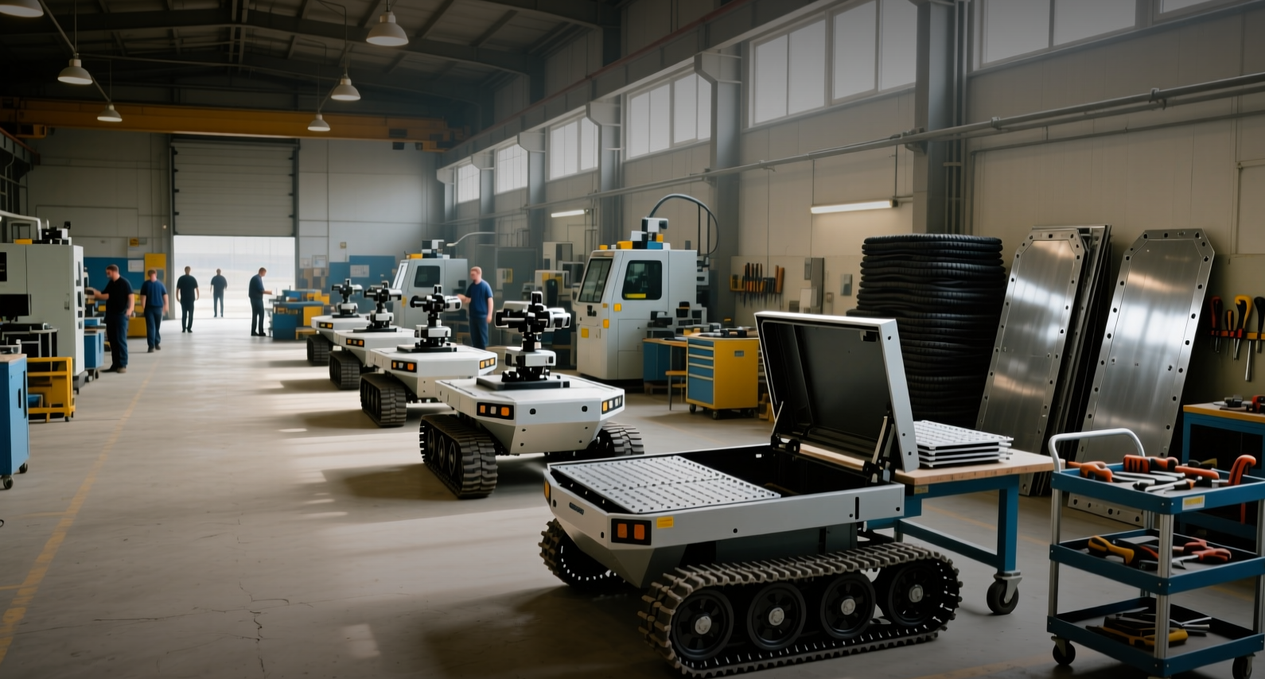
The strategic logic rests on a division of labor that Swarmer has built its identity around. The company does not manufacture drones or vehicles; it sells vendor-agnostic software that lets a single operator control hundreds of autonomous platforms in real time, and says it has supported more than 100,000 combat missions in Ukraine since April 2024. Ratel supplies the metal. Its modular UGVs already run battlefield logistics, casualty evacuation, reconnaissance, drone launching and demining missions, and the company is developing two UAV variants, mobile workshops and solar-powered trailers.
Ratel's 37% procurement share anchors the earnout math
The valuation case is unusually concrete for a private Ukrainian manufacturer. Ratel's products accounted for roughly 37% of the 11 billion hryvnia ($246.85 million) that Ukraine's Ministry of Defense Procurement Agency spent on UGV contracts between Jan. 1 and April 18, 2026, according to the companies. Ratel has also secured contracts totaling $86 million this year and is in discussions with multiple NATO nations under the "Build With Ukraine" initiative.
That procurement concentration cuts both ways. It gives Swarmer a revenue base that is already flowing through a government buyer, but it also ties the earnout to a single ministry's budget cycle and to a war whose procurement priorities can shift quarter to quarter. Ratel's serial Ratel H and Ratel M models carry NATO stock numbers under NCAGE code A3X8J and hold AQAP 2110 certification, the alliance's quality assurance standard for design, development and production — credentials that matter more for the NATO pipeline than for the domestic one.
Ratel brings more than 300 employees who are expected to join Swarmer on closing, taking the combined company to nearly 500 staff. Founder and CEO Taras Ostapchuk, who served in Ukraine's armed forces, will stay in his role and report directly to Fink.
"Having served in the armed forces of Ukraine, I understand firsthand the risks soldiers face on the battlefield," Ostapchuk said. "That experience inspired me to create robotic systems capable of taking on the most dangerous missions and protecting human lives."
Prince's platform thesis gets its first test
Prince framed the purchase as the opening move of a deliberate assembly strategy rather than a one-off. "In my recent letter to shareholders, I stated our objective to build a platform company for products that have been tested on the battlefield and proven effective under the most demanding operational conditions," he said. "Ratel precisely fits that mission."
The precedent worth watching is how defense-technology acquirers have historically been rewarded for buying combat-proven suppliers versus buying capability on a slide deck. Anduril's string of acquisitions and the premium multiples paid for battle-tested drone makers since 2022 have set the benchmark: buyers with fielded systems and government contracts have commanded valuations that hardware-only peers without deployment records have not. Swarmer is applying that template at a smaller scale, using stock as a meaningful component of consideration — a structure that ties Ratel's founders to the combined equity and defers much of the cost until milestones are met.
For Swarmer shareholders, the immediate question is dilution against delivery. The company is paying up to $224 million for a business that has booked $86 million of contracts this year, a ratio that only works if the NATO pipeline converts and if Ratel's UGV chassis becomes the launch platform for Swarmer's software across multiple unmanned domains. Institutional positioning has been building: BlackRock added 248,167 shares in the second quarter of 2026, an estimated $10.99 million, while State Street added 56,950 shares and UBS Group added 56,907, according to 13F filings. HRT Financial exited its position entirely, removing 53,567 shares.
The next hard data points are the closing conditions and the first earnout measurement. If NATO procurement under Build With Ukraine converts into signed contracts, the $224 million ceiling looks cheap against a $246.85 million annual domestic UGV market that Ratel already dominates. If the pipeline stalls, Swarmer has bought a Ukrainian manufacturer at a multiple its own software revenue does not yet support.
This article is for informational purposes only and does not constitute investment advice.