

Taiwan Semiconductor Manufacturing controls roughly 70% of global foundry capacity and exclusively produces Nvidia's Blackwell chips, making it the single most important hardware supplier in the artificial intelligence boom.
Taiwan Semiconductor Manufacturing controls roughly 70% of global foundry capacity and exclusively produces Nvidia's Blackwell chips, making it the single most important hardware supplier in the artificial intelligence boom.
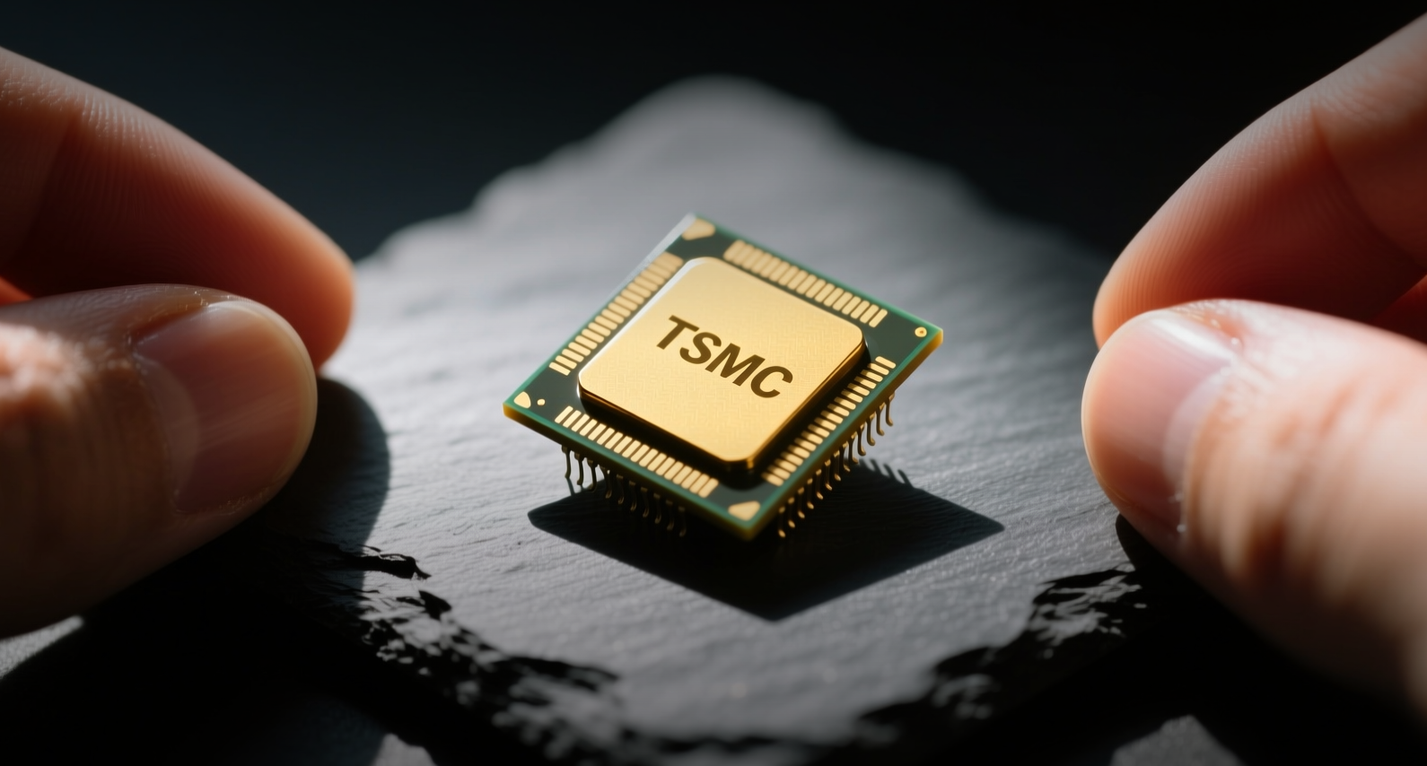
The July tech rotation knocked shares of Taiwan Semiconductor Manufacturing lower, but the selloff masked a simple reality: the company that manufactures every major AI chip just posted 30% revenue growth and is guiding for more.
"TSMC remains a top beneficiary of AI infrastructure demand, with Q2 revenues of $39.6 billion near the high end of guidance," an analyst at The Aerospace Forum wrote, maintaining a strong buy rating and a $504 price target that implies roughly 20% upside from current levels.
May 2026 net revenue landed at NT$416.98 billion, up 30.1% year over year, while cumulative revenue through the first five months reached NT$1.96 trillion, also up 30%. Q1 net income jumped 43.82% to NT$572.8 billion on revenue of NT$1.134 trillion, up 21.45%. The company operates with 58.1% operating margins and a 36.2% return on equity — financial metrics that reflect monopoly economics, not cyclical semiconductor pricing.
The selloff handed investors a discount on the one company that physically manufactures the AI future. With a forward P/E of 31, 17 buy ratings and zero sells on Wall Street, and a geographic expansion that is actively engineering down the Taiwan risk premium, TSM offers a rare combination of pricing power and compounding growth.
Every serious AI chip on earth runs through TSMC's fabs. Nvidia's Blackwell architecture, the accelerators from Apple, AMD, Broadcom, and the custom silicon reshaping hyperscaler data centers all funnel into the same foundry. When a company commands roughly 70% of global foundry capacity and serves as the exclusive producer for Nvidia's most advanced architecture, it becomes infrastructure — not just a supplier.
CEO C.C. Wei has guided to more than 30% full-year revenue growth for 2026, and the numbers are backing that guidance. Q2 revenues of $39.6 billion came in near the high end of the company's own forecast. The upcoming 2nm node (which packs more transistors per square millimeter, improving performance per watt) represents the next catalyst for both revenue growth and pricing power, as only TSMC and Samsung Foundry have the capability to produce at that scale.
The political risk premium that scared investors for a decade is being actively engineered down. TSMC's Arizona fab is now eligible for a 35% U.S. investment tax credit, up from 25%, effective Jan. 1, 2026. Government subsidies underpinning the Germany (ESMC) and Japan (JASM) plants mean the single-source concentration risk that once justified a valuation discount is shrinking with each new fab. The Arizona facility alone represents a structural shift: producing advanced chips on U.S. soil eliminates the supply-chain vulnerability that has weighed on TSMC's valuation for years.
For investors, the math is straightforward. TSM trades at a trailing P/E of 39 and a forward P/E of 31 — a premium that reflects monopoly economics, not hype. Operating margins of 58.1% and return on equity of 36.2% put it in a category occupied by few companies at any valuation. With 17 buy ratings, two holds, and zero sell ratings on Wall Street, the analyst community sees the same thesis: a foundry monopoly compounding at 30% annually, and the recent rotation simply made the entry price more attractive. The question is not whether TSMC will grow — it is whether investors will wait for the next macro panic to buy.
This article is for informational purposes only and does not constitute investment advice.
