
Tesla unveiled its purpose-built Cybercab on Sept. 3, but Goldman Sachs and Barclays kept cautious stances, flagging an Austin fleet under 100 vehicles and unproven production-cost and expansion targets.
Tesla unveiled its purpose-built Cybercab on Sept. 3, but Goldman Sachs and Barclays kept cautious stances, flagging an Austin fleet under 100 vehicles and unproven production-cost and expansion targets.
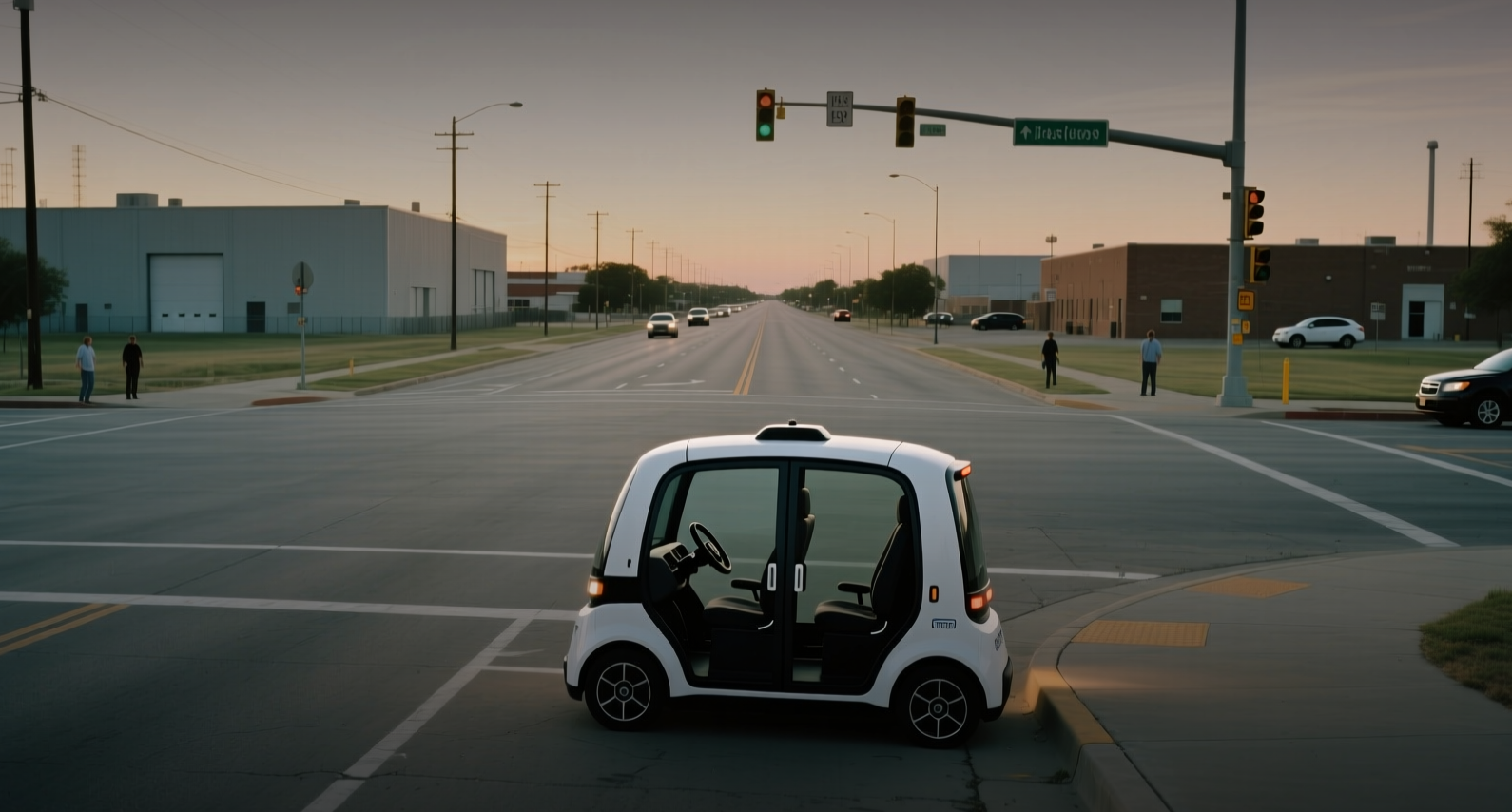
Tesla's Cybercab targets a $20,000-$30,000 scaled unit cost that could undercut rivals by $0.05-$0.30 per mile, yet fleet scale, not hardware cost, will decide whether the Robotaxi business generates revenue.
Goldman Sachs and Barclays both kept cautious outlooks after the Sept. 3 launch, with Barclays noting Tesla's Austin Robotaxi fleet still numbered under 100 vehicles and the event offered no new growth or financial targets.
The two-seat Cybercab, Tesla's first purpose-built autonomous vehicle with no steering wheel or pedals, is built with the company's "unboxing" process that Tesla says can cut production costs by as much as 50 percent. Texas records show 45 Cybercabs registered ahead of the launch, though Goldman cautioned not all may be in commercial service.
Tesla has logged 1 million unsupervised autonomous miles since starting driverless rides, and public Cybercab fares open in Austin on Sept. 4. How quickly the company replicates the service beyond Texas will shape how much of the autonomy premium investors assign to the stock.
Cost Edge Hinges on the Unboxing Ramp
Goldman estimates that holding Cybercab's scaled production cost to $20,000-$30,000, against $50,000-$100,000 upfront vehicle cost for some competitors, yields a per-mile advantage of $0.05-$0.30. The vehicle carries a 48-kilowatt-hour battery, a single 219-horsepower front motor and roughly 290-300 miles of EPA range, with dry-cathode 4680 cells built for a 500,000-mile design life. Tesla has not published fleet pricing or delivery timelines, though it has discussed a target near $25,000-$30,000 per vehicle.
Tesla opened a public interest form Sept. 3 for companies seeking to buy Cybercab fleets, and fleets have appeared at Miami International Airport and near Philadelphia, where no active Robotaxi geofence exists. The Robotaxi app now lets Austin riders choose between the two-seat Cybercab and the four-seat Model Y that has carried the service since mid-2025. Tesla Asia also plans static Cybercab displays this month in Hong Kong, Tokyo, Beijing and Shanghai, a marketing push timed to the Austin momentum rather than a service launch.
Software, Not Steel, Sets the Ceiling
Goldman argues the near-to-mid-term driver of Robotaxi economics is not vehicle cost but whether Tesla's vision-based AI — eight external cameras, no lidar — can scale across regions at low marginal cost. Barclays sees the low-cost vehicle and map-free approach as advantages once the software matures, but says expansion has been slow. Rivals such as Baidu's Apollo Go and Pony AI already run driverless fleets in Chinese cities, giving Tesla a narrower window to prove its software generalizes beyond Texas.
Tesla's FSD supervised data show HW4 vehicles running about 60 percent of miles on highways and 40 percent on city roads, with automatic emergency braking triggers down 75-85 percent and minor and major collisions down 40-90 percent. Robotaxi safety is improving too: Tesla averages one accident per 50,000-70,000 miles across Austin, Dallas and Houston, per NHTSA collision data and Tesla's disclosed driverless mileage, with no incidents recorded in January-March and the first half of July. The operating scale remains too small to prove large-scale safety, and Europe's FSD data, collected by trained engineering operators, is not directly comparable to North America's. Tesla won its first European FSD temporary approval in the Netherlands in April, followed by four more EU countries, with a broader EU vote possible as early as October.
Tesla trades on the promise that autonomy turns its vehicle fleet into a high-margin service. Until Cybercab's unboxing line proves the cost target and the fleet grows beyond a few dozen cars in one city, the revenue case rests on software that has yet to run at scale.
This article is for informational purposes only and does not constitute investment advice.
