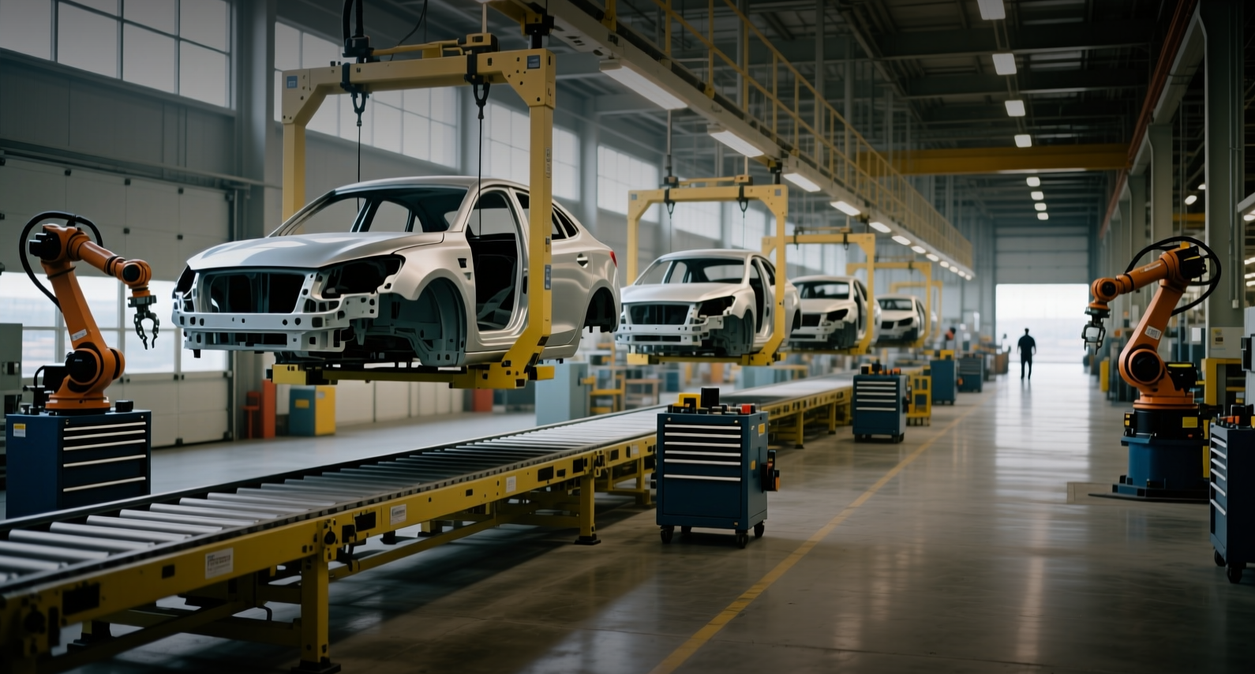
A proposed 50 percent US tariff on Canadian car imports could force Toyota and Honda to shutter assembly lines in Canada.
US President Donald Trump's proposed 50 percent tariff on Canadian car imports would hit Toyota and Honda hardest, with the two Japanese automakers accounting for more than three-quarters of all vehicles built in Canada. The levy, set to take effect Jan 1, 2027, doubles the current 25 percent rate and targets Ottawa after trade talks collapsed.
"If you really wanted to destroy the Canadian auto industry, you could with these tariffs," said Julie Boote, autos analyst at Pelham Smithers Associates in London. Both companies would likely have to close some of their Canadian assembly lines, she said.
Canadian-built cars accounted for almost a quarter of Honda's US sales and 17 percent of Toyota's in 2025, the most among major automakers, according to Barclays analysts. Toyota exports the RAV4 from Canada while Honda ships the CR-V — both among the best-selling SUVs in the United States. Canada's auto industry produces about 1.2 million cars a year and indirectly supports some 427,000 jobs.
The timing could not be worse for Japanese automakers, which are already losing share to low-cost Chinese EVs in Southeast Asia, Europe and Latin America. The United States remains Toyota and Honda's biggest market — and one where Chinese rivals such as BYD are not allowed in.
Tariffs Cost Toyota $8.8 Billion
The proposed tariffs are the latest example of Trump trade policies that have left the global auto industry scrambling to adapt. For years, US, European, Japanese and South Korean car companies and their suppliers built production chains across North America, taking advantage of cross-border trade deals and, especially in Mexico, lower labor costs.
But cost dynamics have changed drastically. US tariffs cost Toyota some 1.4 trillion yen ($8.8 billion) in the last financial year. Toyota is now doubling down on US production, aiming to invest up to $10 billion over five years to expand its US operations, including a new $3.6 billion plant in Texas where it intends to move production of the Tacoma pickup truck from its Baja California plant in Mexico.
For Honda, which is struggling to turn around its money-losing car business, tariffs have added to the strain. A senior executive recently told reporters the company might not build an eighth assembly plant in North America unless United States-Mexico-Canada Agreement free trade talks are extended. USMCA, the revised version of the 1994 Nafta pact, has been in place for six years. Trump opted on July 1 not to renew it, subjecting it to annual reviews, although talks have continued. Last year, South Korea's Hyundai said uncertainty about USMCA was delaying its investment decisions.
A Major Shift for North American Supply Chains
If the tariffs take effect, Toyota and Honda would likely try to redirect Canadian-built vehicles to other markets and then find ways to make up supply for the US market — hardly an easy task, analysts said. US-bound vehicles are often tailored to the market's needs and regulations, while factories elsewhere may already be operating near capacity.
"It would represent a major shift from the past," said Seiji Sugiura, a senior analyst at Tokai Tokyo Intelligence Laboratory.
Two Japanese suppliers said they were unsure what would happen next and that it remained, at least for now, impossible to plan given uncertainty over whether the tariffs would go into effect. "We're trying not to overreact," one supplier executive said.
The stakes extend beyond the two automakers. A 50 percent tariff would add roughly $12,000 to the sticker price of a $48,000 Canadian-built SUV crossing into the United States, eroding demand for models that anchor Toyota and Honda's North American lineups. With USMCA's future uncertain and annual reviews looming, the tariff threat could also deter fresh investment across the region's integrated supply chain, which spans parts makers in all three countries.
This article is for informational purposes only and does not constitute investment advice.