

Xiaomi's 3nm flagship chip crossed 5 million AnTuTu, but a 60-micron joke etched into the silicon stole the show.
Xiaomi's 3nm flagship chip crossed 5 million AnTuTu, but a 60-micron joke etched into the silicon stole the show.
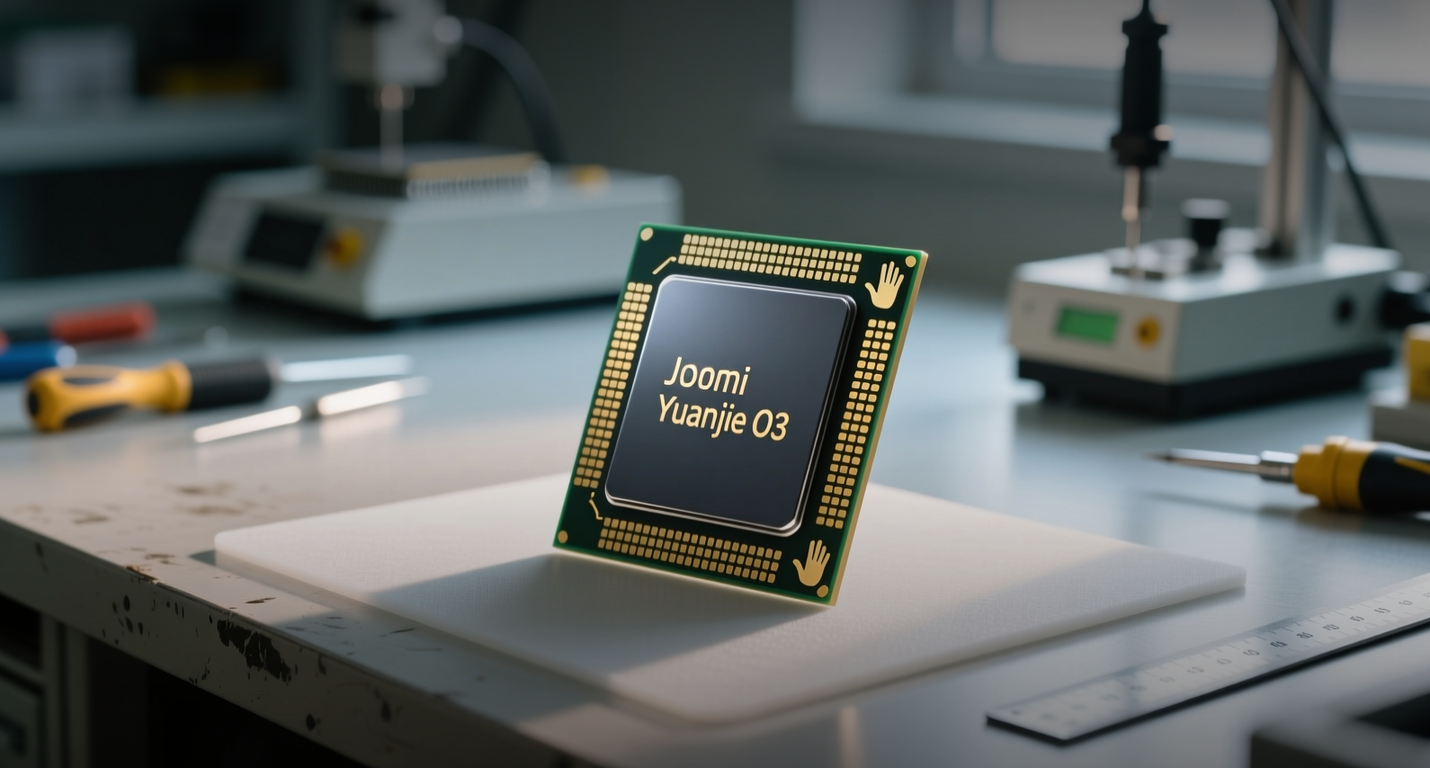
Xiaomi's Xuanjie O3, its first 3nm flagship system-on-chip, scored 5.22 million on AnTuTu V11 — the first mobile processor to cross the 5 million threshold — while packing 24 billion transistors into a 133mm² die.
"The O3 delivers a 60 percent CPU performance gain and an 85 percent graphics improvement over the previous generation," Zhu Dan, Xiaomi's vice president and chip business head, said at the August 24 media briefing.
The chip uses a 10-core all-big-core CPU layout — six super-large cores plus four large cores — running up to 4.35GHz, paired with a 16-core G2-Ultra NX GPU that draws 64 percent less power. It is Xiaomi's first mobile chip with LPDDR6 memory support, delivering 113.8GB/s of bandwidth, and its NPU reaches 200 TOPS of tensor computing power. Development took 459 days.
The O3 will power the Xiaomi 18 Fold and Pad 9 Pro Max, both launching in September. The chip deepens Xiaomi's push to reduce reliance on Qualcomm and MediaTek, a strategy that carries strategic weight as China's domestic semiconductor push accelerates under export restrictions.
The 10-core all-big-core design marks a departure from the big.LITTLE architecture used by Qualcomm's Snapdragon 8 Gen 4 and MediaTek's Dimensity 9400, which pair performance cores with efficiency cores. Xiaomi's approach prioritizes raw multi-core throughput, a choice that could pay off in AI workloads and gaming where sustained performance matters more than battery optimization.
The G2-Ultra NX GPU supports third-generation ray tracing and integrates neural-network acceleration directly into the graphics architecture. Xiaomi claims the 16-core GPU achieves its 85 percent performance gain while consuming 64 percent less power, a combination that could be significant for sustained gaming workloads where thermal throttling typically limits performance.
On the AI front, the O3 distributes acceleration across the CPU, GPU, ISP, DPU, and ADSP rather than concentrating it in a single NPU. The 200 TOPS tensor performance and 3.13 TFLOPS vector performance put it in the same class as Apple's A18 Pro and ahead of most Android competitors on paper, though independent benchmarks have not yet verified Xiaomi's claims.
The most discussed feature of the launch was not the transistor count or benchmark score. Engineers etched a 60-micron "OK" hand sign onto the chip, a nod to founder Lei Jun's 2015 "Are you OK?" moment at a Xiaomi India event — a phrase that became one of the most durable memes in Chinese internet culture. Lei demonstrated the gesture on camera and, with a grin, warned buyers against taking apart the chip to find it. "The chip is expensive," he said.
The easter egg doubles as a tamper-evident signature — the OK mark is parody and provenance at once, a way for Xiaomi to laugh at itself while the serious engineering happens underneath.
Alongside the O3, Xiaomi announced two additional chips: the Xuanjie O100, a 6nm high-bandwidth AI accelerator with 1.22Tbps of near-memory computing bandwidth, and the Xuanjie D100, the automaker's first 3nm self-driving AI chip with a 20-core CPU, 16-core NPU, and support for up to 160GB of unified memory. The O100 targets on-device AI across phones, cars, and robots; the D100 is slated for commercial use in 2027.
Xiaomi also unveiled a prototype mini-PC called the AI Cube, powered by all three chips, capable of running large language models from 3B to 120B parameters locally. The company has not given a release date or price for the device.
The launch extends China's domestic chip push, which has gained momentum as US export controls restrict access to advanced semiconductor technology. Xiaomi's decision to announce the chip via a text-and-image live blog rather than a stage show — a format the company has used for its previous chip announcements — reflects how far the in-house silicon program has come since the Xuanjie O1 debuted 459 days ago.
For investors, the O3's real test comes in September when the Xiaomi 18 Fold ships. The 5.22 million AnTuTu score is a laboratory figure; sustained performance, thermal control, and battery efficiency will determine whether it can genuinely compete with Qualcomm's Snapdragon 8 Gen 4 and MediaTek's Dimensity 9400 in real-world use. Xiaomi's stock has priced in the semiconductor self-sufficiency narrative, but the market will need to see the O3 deliver on its claims before assigning lasting value to the in-house silicon strategy.
This article is for informational purposes only and does not constitute investment advice.
